
Should You Look Up Every Unknown Word in an English Book?
Published

Looking up every unfamiliar word can bring your reading to a halt. Skipping every word can leave you feeling that you learned nothing. The practical answer is: you do not need to look up everything. Look up words that block the story, save expressions you want to use, keep the whole sentence, and review it aloud later. This article gives you a simple way to decide.
One condition comes first. If a page contains too many unknown words, changing books will help more than changing dictionaries. We will also give you a way to judge the level.
Why you should not look up everything
Extensive reading often follows three rules: do not use a dictionary, skip what you do not understand, and stop reading a book that does not suit you. Constant dictionary use breaks the rhythm that makes sustained reading possible.
That advice assumes that you already know most of the words. The Extensive Reading Foundation says that knowing about 98% of the words on a page supports fast reading with high comprehension. Below 90%—one unknown word in ten—reading becomes slow, frustrating, and dependent on a dictionary. At 98%, roughly one word in fifty is unfamiliar.
The vocabulary required is substantial. Nation (2006) estimated that 8,000–9,000 word families are needed for 98% coverage of written text. For many learners, a novel with no unfamiliar vocabulary is not a realistic starting point. The useful choice lies between the extremes: decide which words deserve your attention.
Three questions: look it up or skip it?
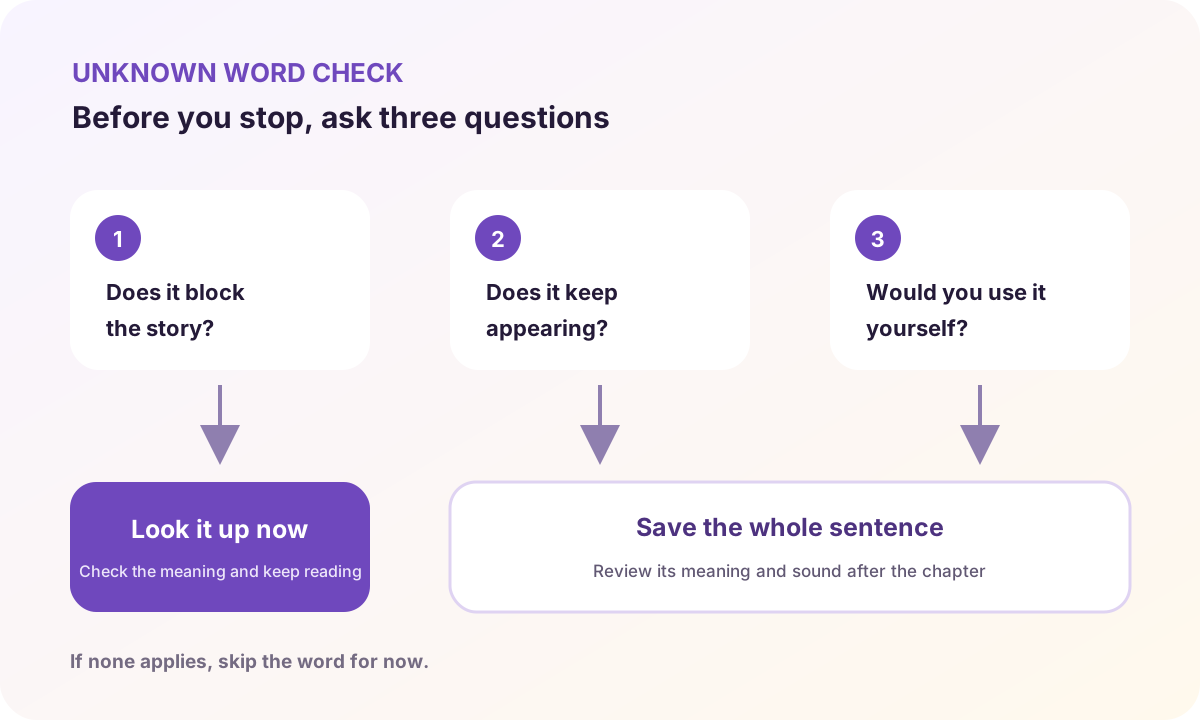
Ask these questions in order.
1. Does the word stop you following what happens? Look it up if you cannot tell who did what or how the scene changed. If one adjective or adverb is missing but the scene still makes sense, keep reading. In “She hesitated at the door, then knocked twice,” you may understand enough to continue before learning that hesitated means she paused because she was unsure.
2. Does it keep appearing? A word that appears for the second or third time is probably important in that book. Looking it up then lets the earlier contexts help you confirm its meaning.
3. Would you like to use the expression yourself? If you understand a phrase but could not produce it in conversation or writing, save it. It is more useful as material for practice than as another dictionary entry.
Skip words that meet none of these conditions. Webb (2008) found that richer context supported learning meaning more than encounter count, while repeated encounters better supported knowledge of form. Use context when it offers clues; use a dictionary when the clues are not enough to follow the text.
Check whether the book is at the right level
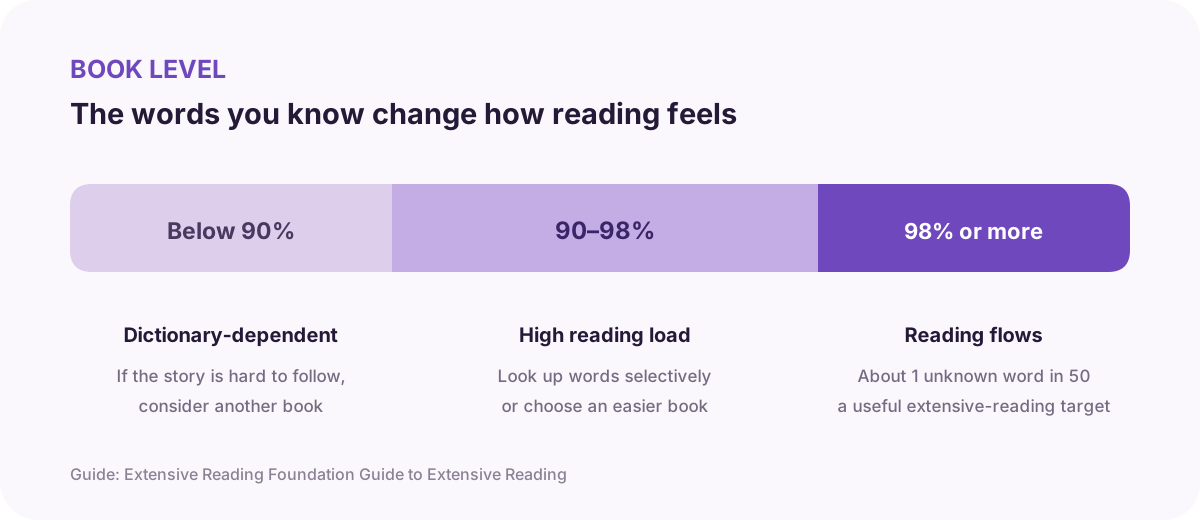
If several words on every page answer “yes” to the first question, the book is probably too difficult right now. Two different guidelines can help:
- Coverage: the Extensive Reading Foundation describes 98% or more as comfortable, 90–98% as an instructional level, and below 90% as heavily dependent on dictionary use.
- Words per page: Day and Bamford (2002) suggest that more than one or two unknown words per page may be too difficult for beginners; intermediate learners can use a “rule of hand” of no more than five difficult words per page.
These measures are not identical. A 300-word paperback page at 98% coverage still contains about six unknown words, while a children’s reader has far fewer words per page. Do not obsess over the count. If dictionary use repeatedly interrupts you, move to a graded reader, a children’s book, or the original of a story you already know.
Save the whole sentence, not only the word
A word and its translation often fail to bring the scene back later. Many words have several meanings, and the sentence determines which one is active. Save:
- the complete English sentence, or a complete clause if it is long;
- a one-line meaning in that context;
- the book title and page or Kindle location;
- a short reason such as “I want to use this” or “it appeared repeatedly.”
On Kindle, highlight the sentence after checking it and review the highlights later. In a paper book, add a tab and copy selected sentences at the end of the chapter. Keep the note-taking out of the reading session. Save only an amount you can really revisit—a few sentences per chapter is a reasonable place to start.
Review the expression and say it aloud
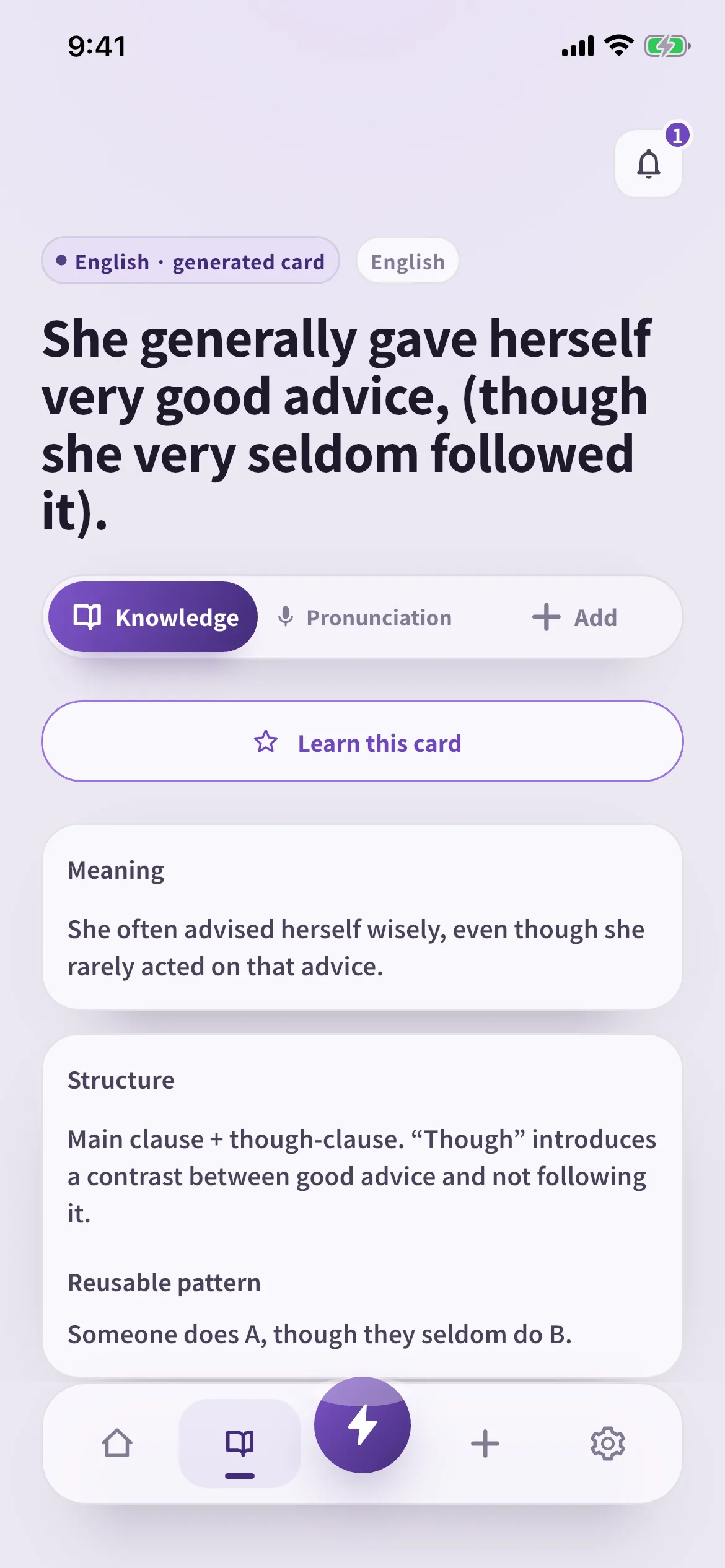
Review saved sentences at the end of the chapter and again after finishing the book. Hide the translation and check whether you can explain the English sentence. Then read it aloud. A sentence you understand silently may still be difficult to produce; the sentences where you hesitate are the ones to practise next.
If you want audio while practising, you can use SpeakGain, the app we develop. Add an English sentence and it becomes a card with generated English audio and an AI explanation, including its meaning, paraphrases, and examples with the same pattern. You can repeat the audio and optionally record yourself for pronunciation feedback. SpeakGain also uses your practice history to suggest what to review next.
Will skipping words really build vocabulary?
Extensive reading and deliberate vocabulary practice solve different problems. Reading gives you repeated encounters and useful context; selected review helps you retain expressions you want to understand or use. Reaching the vocabulary needed to read novels without support takes time, so waiting for every word to become clear by itself is inefficient. Combine both: keep the story moving, then practise the small number of expressions worth keeping.
Summary
- Do not look up every unknown word. Prioritise words that block the story, recur, or express something you want to say.
- If you need the dictionary constantly, choose an easier book.
- Save the sentence, its source, and why you kept it.
- Review at chapter and book boundaries, and check whether you can say it aloud.
References
- Extensive Reading Foundation. The Extensive Reading Foundation’s Guide to Extensive Reading.
- Day, R. R., & Bamford, J. (2002). Top ten principles for teaching extensive reading. Reading in a Foreign Language, 14(2).
- Nation, I. S. P. (2006). How large a vocabulary is needed for reading and listening?. Canadian Modern Language Review, 63(1), 59–82.
- Webb, S. (2008). The effects of context on incidental vocabulary learning. Reading in a Foreign Language, 20(2).
- NPO Tadoku Supporters. The three golden rules of Tadoku.
- Yahoo! Chiebukuro. When reading English books, people say it is important to keep going without looking up unknown words… (2010) — An example of a learner asking whether simply skipping unfamiliar words can really build vocabulary.