
Free English learning apps: choose by free limits, with useful websites
Published Updated
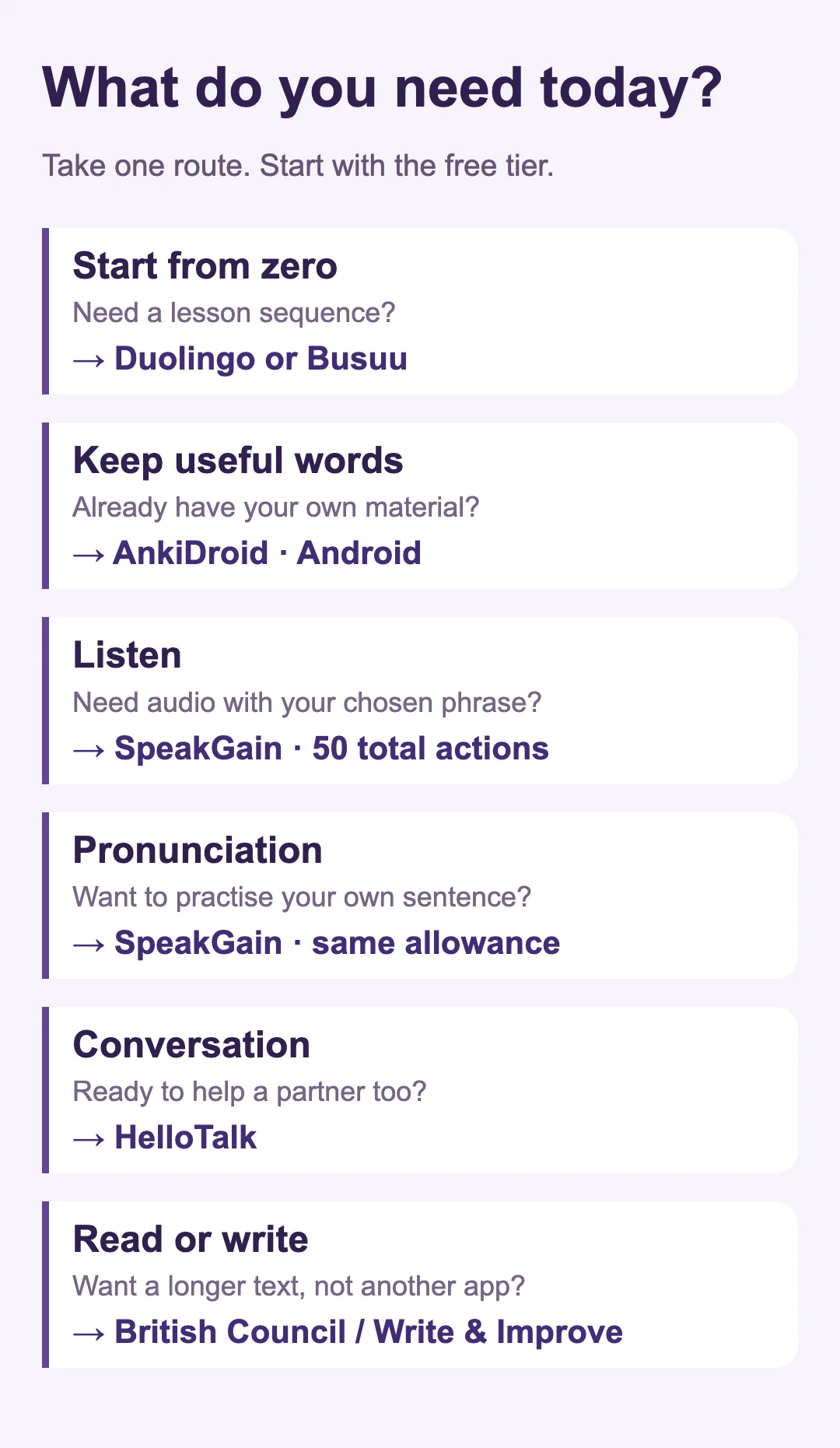
For a free English learning app, pick Duolingo for a guided beginning, AnkiDroid for your own vocabulary on Android, or HelloTalk for language exchange with people. AnkiDroid has no subscription; Duolingo and HelloTalk keep a free tier with restrictions, while a Super Duolingo trial gives temporary access to paid extras. Busuu is another course option with ads, and SpeakGain offers a finite allowance for practising your own phrases.
Choose the job before the app
Your first installation should solve today’s problem. If you cannot decide what to study, choose a course; if you already have useful words, choose a place to review them. A conversation partner solves a different problem from a lesson sequence.
What you can do without paying
| App | Free practice and its boundary |
|---|---|
| Duolingo | Guided vocabulary, reading, listening and speaking exercises. Courses remain free with ads; Energy limits the pace of lessons. |
| AnkiDroid | Create and review your own cards on Android, including saved audio. Free and open source; you supply the learning material. |
| Busuu | Follow English lessons by watching an ad before each lesson. Premium adds ad removal and review tools. |
| HelloTalk | Exchange messages with language partners. Free translation is limited to 10 uses a day across the app; VIP removes that translation limit. |
| SpeakGain | Try 50 actions in total across adding cards, translating and pronunciation scoring. Further actions require a monthly or annual plan. |
Duolingo’s Energy explanation describes a battery that runs down during lessons and replenishes over time, with rewarded ads and gem refills. That is a pacing limit, so a strict no-spend routine can stop for the day instead of buying a refill. AnkiDroid’s free Android app is separate from the paid iPhone app AnkiMobile.
Where payment begins
US App Store prices in USD, checked 12 November 2026; AnkiDroid’s Android price comes from its official download page. These are the named items displayed by the stores, not conversions into a monthly rate.
| App | Paid option and displayed price |
|---|---|
| Duolingo | Super removes ads and adds unlimited Energy. Listed Super Duolingo items include $9.99 and $83.99. |
| AnkiDroid | $0; no premium tier for creating or reviewing cards. |
| Busuu | Monthly Premium Plan $23.49; 12 Months’ Premium $138.99. |
| HelloTalk | Monthly auto-renewal VIP $12.99; VIP Membership Yearly $79.99. |
| SpeakGain | Pro (Monthly) $9.99; Pro (Annual) $79.99. No free subscription trial. |
Can you actually say your own sentence?
| App | Speaking role |
|---|---|
| Duolingo | Say the course’s prompts; use a new sentence outside the lesson to connect the topic to your day. |
| AnkiDroid | Put a situation on the front and your sentence on the back; answer aloud before revealing it. |
| Busuu | Course work introduces expressions; Premium Plus includes additional AI conversation and speaking features. |
| HelloTalk | Voice messages and calls let you put your own meaning into an exchange with another learner. |
| SpeakGain | Save a personally useful phrase with audio and an explanation, then revisit it in speaking practice. |
Which app should you install first?
Duolingo: for getting started without planning a syllabus. Use the free course when a clear next exercise matters more than choosing every sentence. If you want to rehearse a specific question for tomorrow, a course may take a long route to it. Avoid starting Super just to begin the free lessons.
AnkiDroid: for words you have already encountered. Its manual covers custom cards, media and offline study. For example, put “What do you need to check before leaving work?” on the front of a card and write your own answer on the back. It is a practical choice for an Android phone with an unreliable connection, but not a ready-made beginner course.
Busuu: for a course with explanations and a lesson sequence. Choose it when a language topic needs more context than a word list. Its plan comparison separates free lessons from paid vocabulary and grammar review and Premium Plus speaking tools; decide whether the free lesson itself is enough before upgrading.
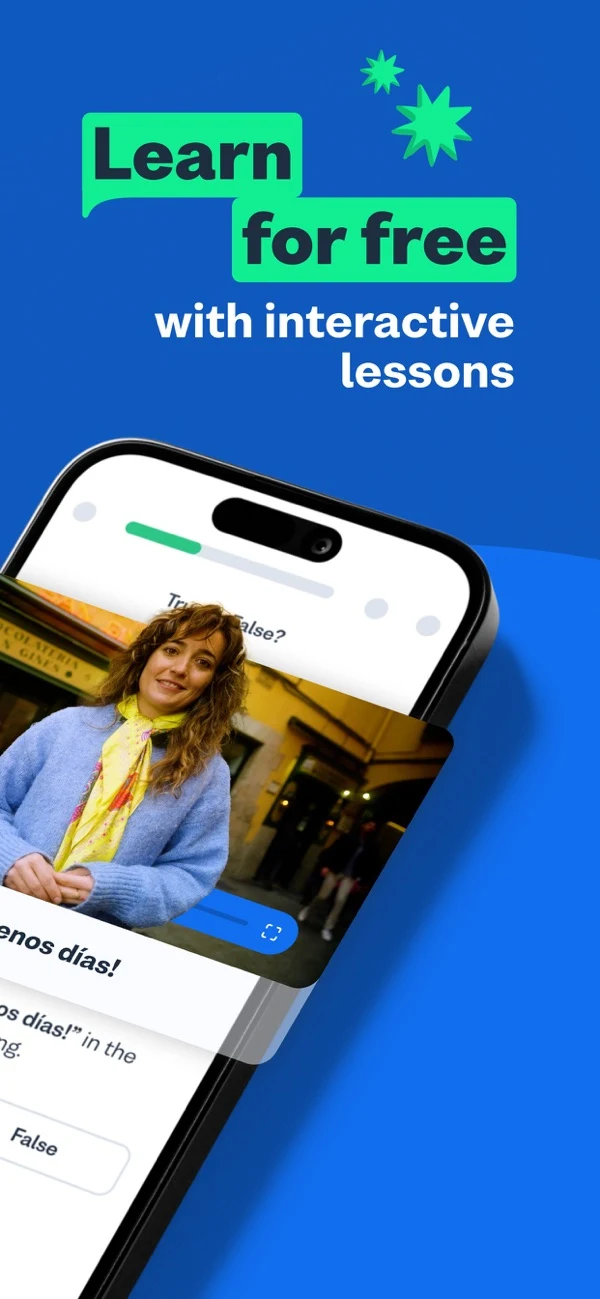
HelloTalk: for exchanging ideas rather than finishing units. Choose it when you can offer help in your language and want an English reply from another person. A useful first exchange could be about the kind of place you like to visit on a day off. It requires finding a willing partner, so it is less suitable when you need a solo exercise at a fixed minute every day.
SpeakGain: for rehearsing a phrase you chose. SpeakGain is published by the team behind this guide. It suits someone who already knows what they want to say and wants that sentence in a review deck; it is less suitable for a learner seeking an unlimited free syllabus. Its 50-action allowance is a total usage budget, not a recurring daily allocation, and there is no free trial of Pro.
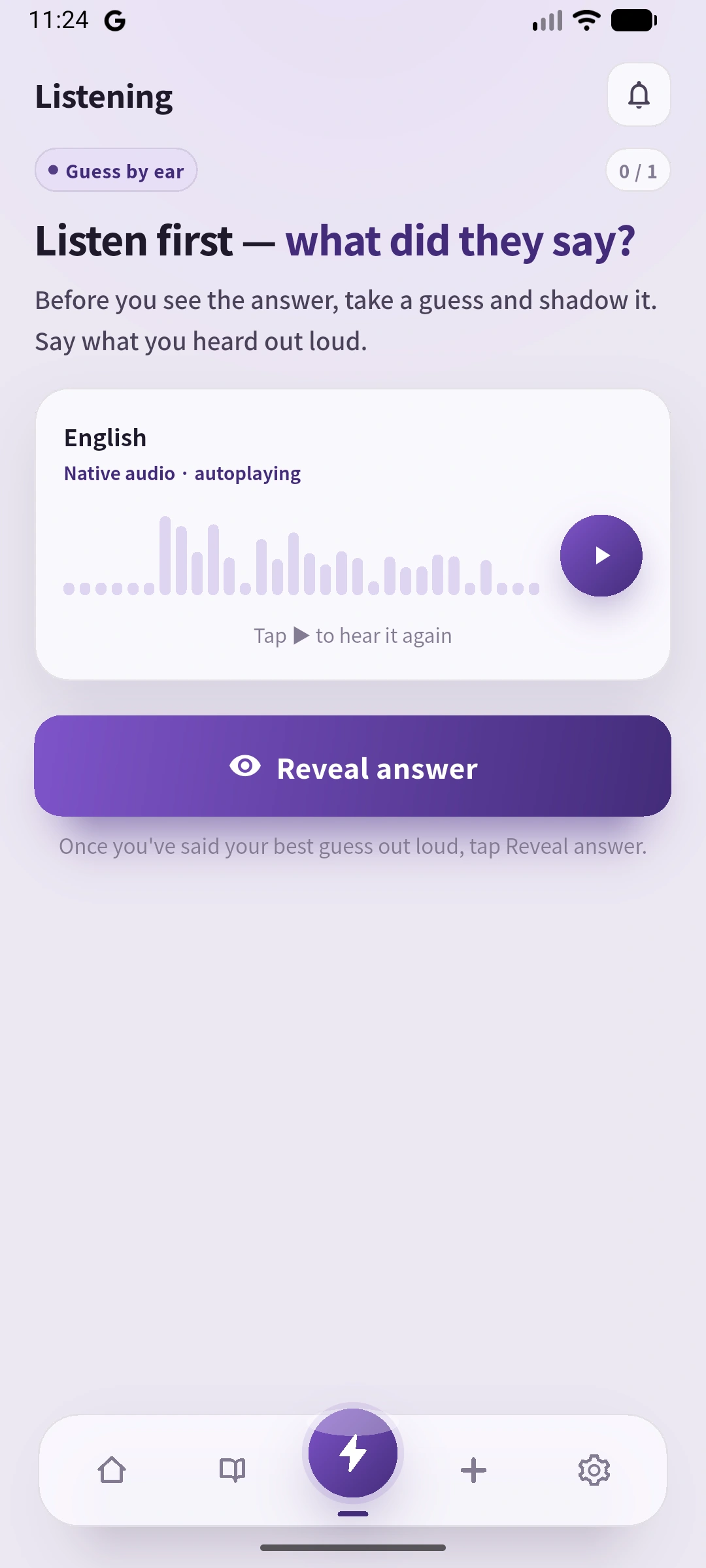
The saved example “I review a few English words after lunch.” gives a phrase a specific time and action. In the pictured Listening exercise, the answer stays hidden until you reveal it: the task starts from the audio rather than from reading the card.
Four kinds of free access
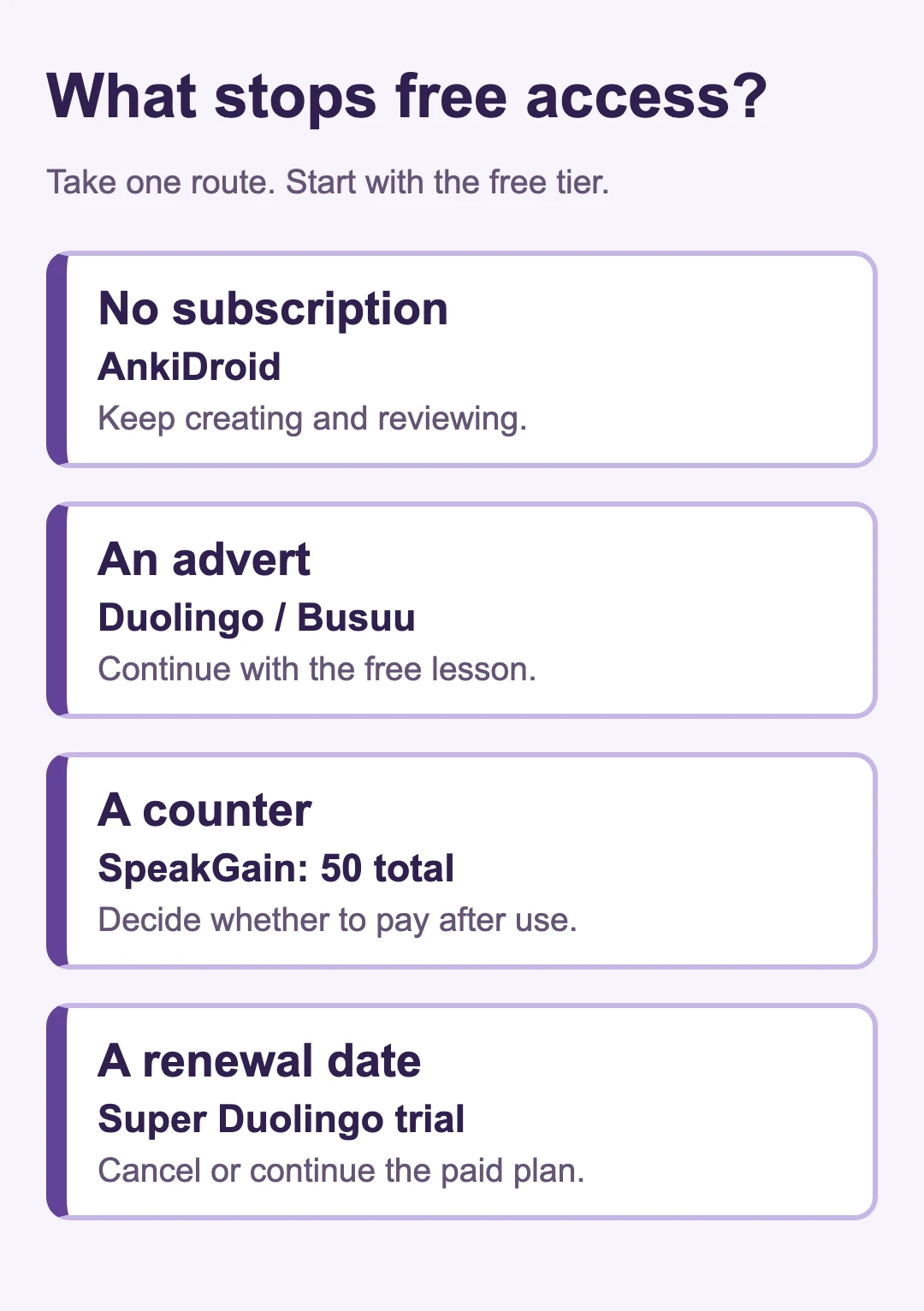
- Ongoing free use: AnkiDroid lets you keep making and reviewing cards without a subscription.
- Ad-supported access: Duolingo and Busuu fund free lessons partly through advertising.
- Limited use: HelloTalk’s translations reset daily; SpeakGain’s 50 actions form one total allowance. A resetting limit and a one-time budget are different.
- A timed trial: Super Duolingo advertises a temporary trial of its paid features. The free course continues without taking that offer. Read the renewal date and cancellation instructions on the purchase screen before accepting.
A free week, with one main app
Choose Duolingo or Busuu as the main course. Each day’s 15 minutes can be split into five minutes of course work, five minutes examining one useful expression and five minutes trying a sentence about your life. If the free app limit arrives sooner, use the remaining time on yesterday’s notes.
| Day | A task that uses free access |
|---|---|
| Monday | Complete a beginner lesson in your chosen course; keep one expression about a routine. |
| Tuesday | Return to that topic and write a different action you actually do. |
| Wednesday | Add the sentence to AnkiDroid on Android, or use a paper card. Put a situation on the front. |
| Thursday | Answer the card aloud before turning it over; compare the verb and time with your intended meaning. |
| Friday | Draft a short HelloTalk message about your routine and decide what to ask your partner. |
| Saturday | Respond to an available partner, or practise a possible reply on your own. |
| Sunday | Review your cards and pick the one topic worth continuing next week. |
A fresh example: “I check tomorrow’s delivery times before I close the shop.” Change “delivery times” to “train times” only if that describes your life. Then answer “What do you check before you leave?” without reading the full sentence. The result you want is a useful reply, not a larger collection of unused apps.
Free websites when you do not want another app
For listening, ELLLO offers conversations with supporting text, while Randall’s ESL Lab pairs listening with activities and funds its free service with ads. For reading, choose British Council’s levelled texts or News in Levels’ short news. For writing, Write & Improve gives automatic feedback on submitted text; Purdue OWL is a free reference for writing conventions.
These sites fill a missing task after you have selected an app. You do not need to open all six in the same week.
FAQ
Which free app is best for a beginner?
Start with Duolingo if you want short, directed exercises, or Busuu if you prefer its lesson format. Keep one course for a week before deciding whether it covers your needs.
Should I avoid advertising?
Decide whether you can finish a useful lesson with the interruptions. AnkiDroid offers a different route if you want your own cards without an ad-supported course.
What happens when a trial ends?
A subscription can renew at the price and interval on the purchase screen. Cancel through the store before its deadline if you only wanted the trial; ordinary free Duolingo lessons do not require a Super subscription.
What should a parent check?
This shortlist is for adults. Check the store age rating, purchase controls and interaction features before choosing for a child; HelloTalk involves contact with other users.
Which option works offline?
AnkiDroid can study locally stored cards and media. Download the material before disconnecting; live HelloTalk exchanges and SpeakGain’s online pronunciation assessment need a connection.
Is SpeakGain permanently free?
It provides 50 combined actions to try the phrase workflow. It is not an unlimited free option after that allowance, and Pro has no free subscription trial. Use AnkiDroid or paper for an ongoing no-subscription card routine.
Keep the choice small
Begin with the app that supplies your missing task, then judge it by one ordinary week of use. A paid feature is worth comparing only when you can name the specific free limit that is blocking you.
For more detailed choices, see our guides to pronunciation, vocabulary, conversation, shadowing, grammar and diary writing.