
How to Learn English by Playing Video Games You Already Enjoy
Published

When people talk about learning English with games, they may mean one of two things: games designed to teach English, or playing a game they already enjoy in English. Search an app store for “English learning” and you will find plenty of the first kind. This article is about the second.
Here is the short answer: do not expect playing alone to make the language stick. Choose a game whose story you know, whose subtitles or dialogue log you can revisit, and whose pace lets you notice the text. While playing, look up only the English needed to progress. Mark short lines you would like to use yourself and keep each complete sentence. After playing, check its meaning and sound, say it aloud, and return to it another day. This keeps the game enjoyable while giving you useful language to retain.
Can playing your favourite game in English help you learn?
Yes, under certain conditions. Choose a game with a substantial amount of English, and keep the work of remembering expressions separate from play. Playing in English will not teach you the whole language by itself; you still need other ways to build foundations such as grammar.
One experiment involved 80 Japanese university students. Some played an English-language music video game, while others watched the same screen beside a player. Both groups recalled vocabulary from the game, but the players recalled fewer words than the watchers. The players reported that it was difficult to attend to both the controls and the English at once (deHaan, Reed, & Kuwada, 2010). This was one experiment with one particular game, so it does not establish what happens in every game. It does show that busy controls can compete with attention to language.
For that practical reason, this article separates time for playing from time for checking. Avoid stopping too often during play, then review the expressions you marked after the session. The steps below follow that approach.
Five checks when choosing a game
Enjoying the game is the first requirement. Then check these five points.
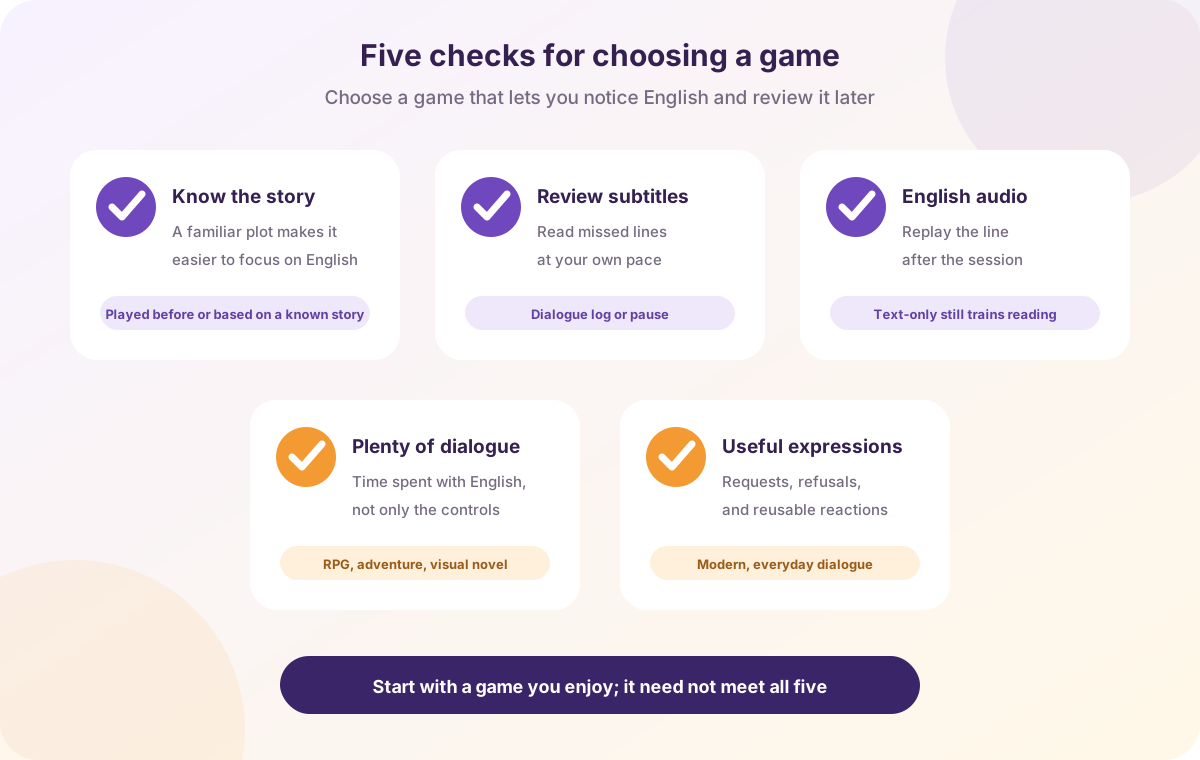
- You already know the story. A game you have completed in your first language, or one based on a book or film you know, is easier to follow. Even when the English is unclear, you can understand what is happening and keep moving.
- You can review English subtitles. A dialogue log, backlog, or pause function lets you read a missed line at your own pace.
- It has English voice acting. Audio lets you revisit how a line sounds. A text-only game can still provide reading practice.
- It contains plenty of text or dialogue. RPGs, adventures, visual novels, and life simulations tend to offer more language. Competitive or action-heavy games often contain less text and demand more attention for controls.
- It contains expressions you could use elsewhere. Contemporary settings and everyday conversations are more likely to offer reusable ways to greet, ask, refuse, or react. Archaic fantasy language and specialist terms may have fewer uses outside the game.
Language support differs by title. Check the supported-language list on the store page. Some games use an in-game language menu rather than the console or computer setting.
Start with audio and subtitles you can understand
You do not need to switch both audio and subtitles to English immediately. Think of three broad stages:
- First-language audio with English subtitles, or English audio with first-language subtitles: follow the story in your language and focus on one English channel;
- English audio with English subtitles: listen while reading;
- English audio only: play without subtitles.
English audio plus English subtitles is not always the best choice. If the combination leaves you unable to follow the story, the fun disappears and you may stop altogether. Use one test: can you follow the plot by reading the subtitles? If not, move back one stage or choose another game. If you already know the story, you may be able to start with English audio and subtitles.
While playing: look it up, infer it, or save it
Looking up every unfamiliar line will bring the game to a halt. Sort new words and dialogue into three groups.
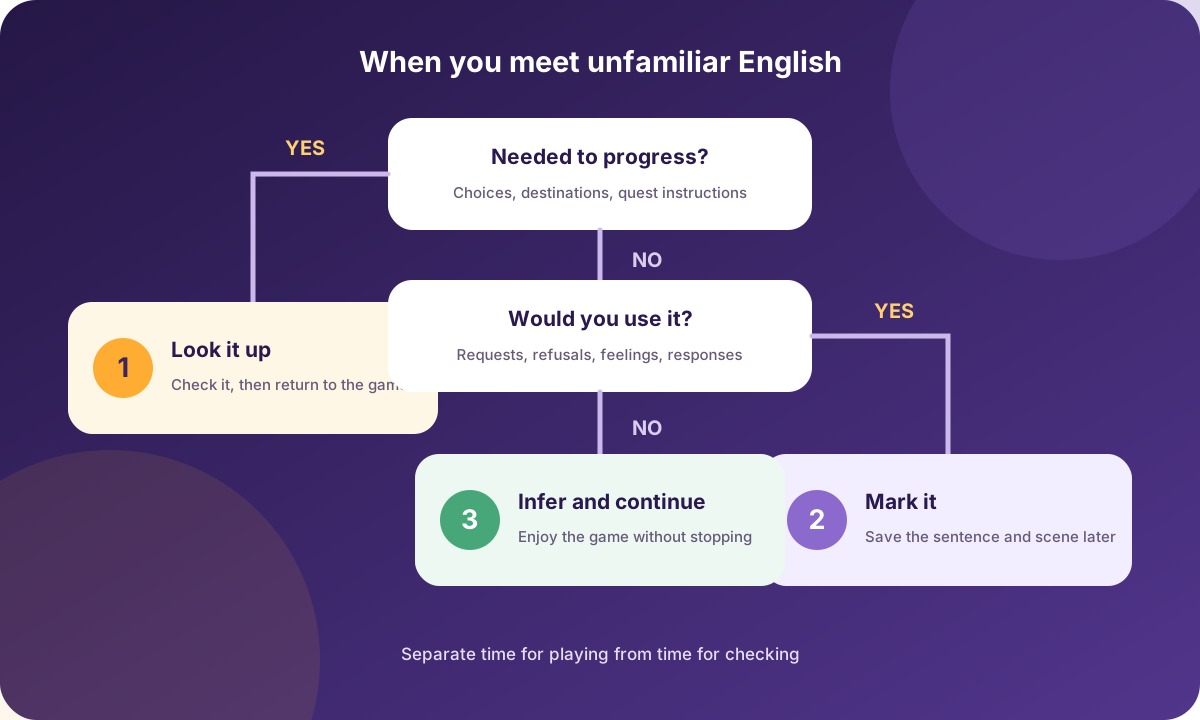
- Stop and look it up. Do this only for language you must understand to continue, such as choices, destinations, or quest instructions. Return to the game as soon as you have checked it.
- Infer and continue. Use context for descriptive or atmospheric words that do not affect the plot. If a word keeps appearing, mark it and move it into the “save for later” group.
- Mark it and save it later. Mark short lines that make you think, “I would like to say that.” Greetings, requests, refusals, emotional reactions, and conversational responses are good candidates. Mark the line now; do not research it yet.
A screenshot, the platform’s capture function, or one sentence in a notebook all work. What matters is preserving who said it and in what situation. A word copied on its own may not bring the scene or its usage back later.
Set a limit on how often you stop—for example, once per conversation. If you need to look up more than that to understand what is happening, the game may currently be too difficult.
After playing: keep the scene and sentence, then say it aloud
After the session, organise the lines you marked. This is the step that separates merely playing from studying. One to three sentences per session is an easy starting point, not a fixed target.
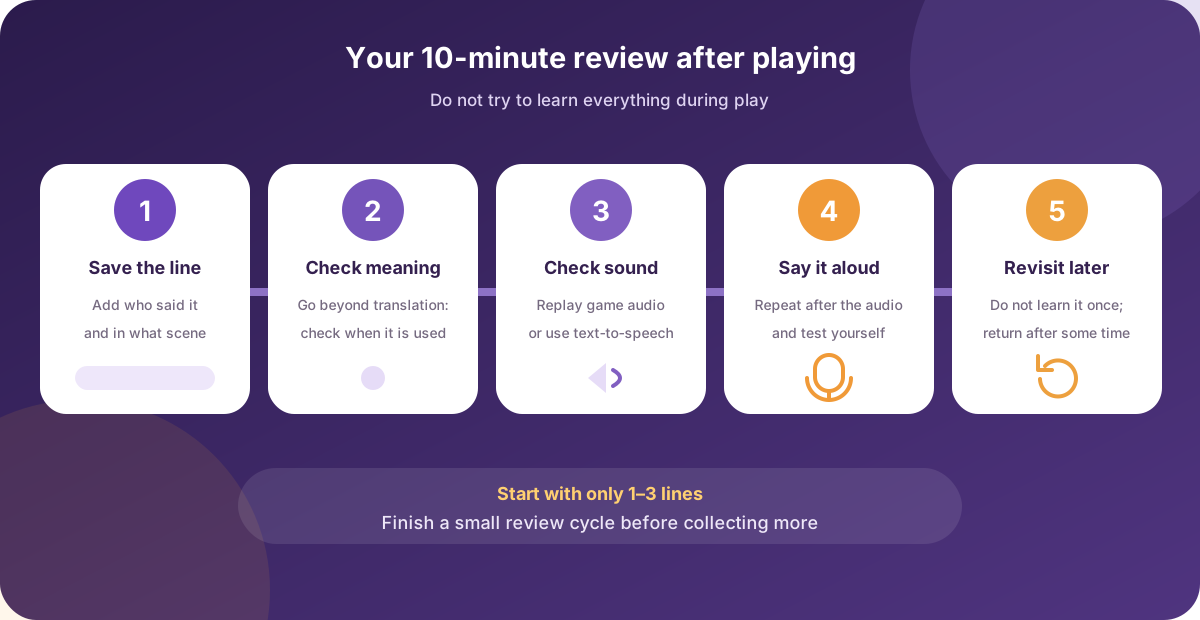
- Save the complete sentence with its scene. Copy the line rather than an isolated word, and add a short note about who said it and where. Webb (2008) found higher scores on meaning tests when Japanese university students encountered the same words ten times in short contexts containing richer clues. The experiment did not test saving game dialogue or screenshots directly. It does support the narrower point that contextual clues can help learners understand meaning. Keeping the sentence is this article’s practical way to preserve those clues.
- Check the meaning. Use a dictionary to confirm the meaning and possible paraphrases. Instead of memorising one translation, ask what situation the expression suits.
- Check the sound. Replay the scene if the game has English audio. For a text-only game, use text-to-speech.
- Say it aloud. Repeat after the audio and see whether you can produce the line. Listen again to words where you stumble. Speaking here is a way to test what you can retrieve.
- Revisit it later. Do not try to learn everything in one sitting. A meta-analysis of 317 experiments found that spacing practice over time affects retention of verbal material (Cepeda et al., 2006). The best interval depends on how long you need to remember something, so there is no universal number of days. Return when the line is starting to fade and say it again.
Begin with an amount that fits into a short period, such as ten minutes before your next session. Finishing a small review cycle matters more than collecting many lines. This is only a starting suggestion, not a guarantee that one routine will suit everyone.
What to adjust when it is not working
- There are too many unfamiliar words on one screen. Choose a game whose story you already know, or move the audio and subtitle combination back one stage.
- The controls are too busy for reading. Choose a genre with pausing or a dialogue log. If you love action games, you can limit English study to the dialogue sections.
- You know the words but not the sentence. The cause may be grammar, an idiom, or missing context. A game lets you experience language in use; it is not a systematic course. Review the relevant foundation in other materials while continuing to play.
- You cannot keep the routine going. Shorten each session and reduce the saved material to one line a day. Treating every part of the game as a lesson can remove the enjoyment that brought you to it.
If you want to review saved dialogue with audio
Everything above can be done with the game, a dictionary, and a notebook. If you want an easier way to hear and practise your saved dialogue aloud, SpeakGain, the app we develop, is one option.
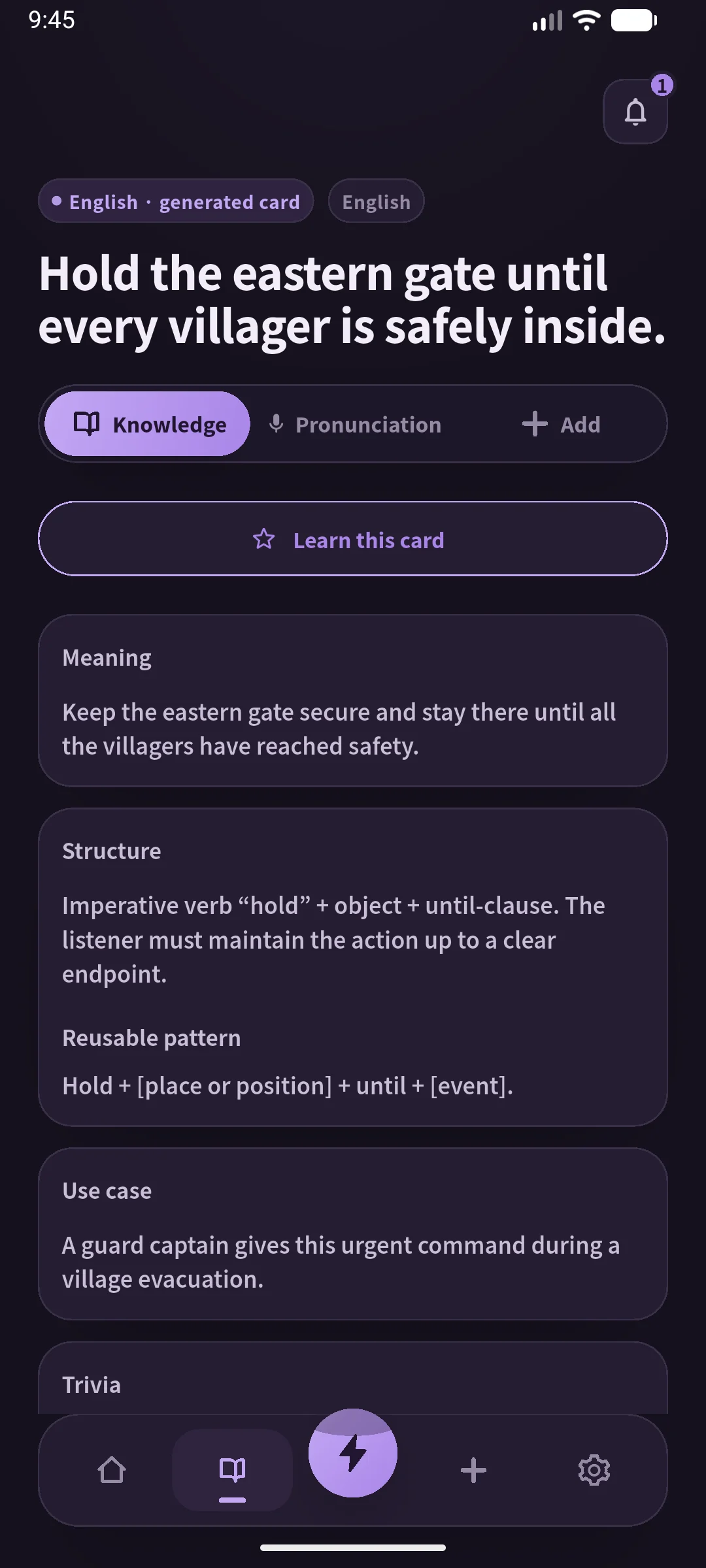
SpeakGain turns an English sentence you enter into a card for spoken practice. A saved line receives generated English audio and an AI explanation with its meaning, paraphrases, and examples. You can listen, repeat aloud, and optionally record yourself to receive online pronunciation scores by word. Based on your practice history, the app also surfaces cards for later review. SpeakGain cannot import dialogue automatically from a game: you still need to enter the line and note who said it and in what scene.
Summary
- First distinguish games designed for language learning from playing a game you enjoy in English.
- For an ordinary commercial game, prefer a familiar story, reviewable subtitles, and substantial dialogue.
- Start with an audio and subtitle combination that still lets you follow the plot.
- While playing, separate language into “look it up,” “infer and continue,” and “mark for later” so that you do not stop too often.
- After playing, keep the complete line and scene, check its meaning and sound, say it aloud, and revisit it later.
Separate the time for playing from the time for checking. That small change turns the game from a place where English merely passes by into a source of expressions you can keep and use.
References
- deHaan, J., Reed, W. M., & Kuwada, K. (2010). The effect of interactivity with a music video game on second language vocabulary recall. Language Learning & Technology, 14(2), 74–94. https://www.lltjournal.org/item/10125-44215/
- Webb, S. (2008). The effects of context on incidental vocabulary learning. Reading in a Foreign Language, 20(2), 232–245. https://scholarspace.manoa.hawaii.edu/bitstream/10125/66826/1/20_2_10125_66826_webb.pdf
- Cepeda, N. J., Pashler, H., Vul, E., Wixted, J. T., & Rohrer, D. (2006). Distributed practice in verbal recall tasks: A review and quantitative synthesis. Psychological Bulletin, 132(3), 354–380. https://pubmed.ncbi.nlm.nih.gov/16719566/