
TOEIC time management: a 2-hour test and a 75-minute Reading plan
Published Updated
The standard TOEIC Listening & Reading test has 200 questions and takes about 2 hours: approximately 45 minutes for Listening and 75 for Reading. Allow longer at the venue for check-in and forms; ETS budgets about 2½ hours including the questionnaire.
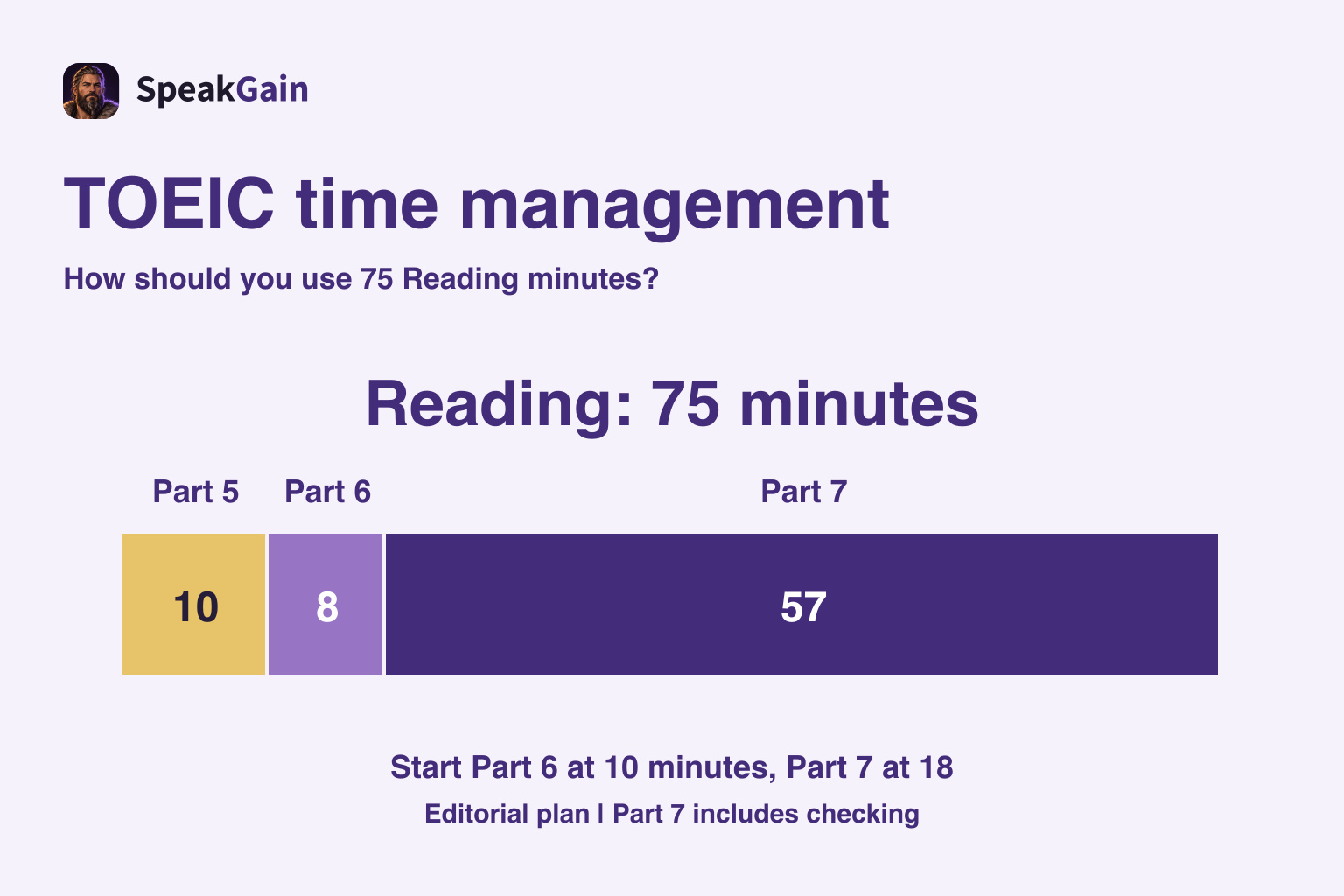
For Reading, start with 10 minutes for Part 5, 8 for Part 6 and 57 for Part 7, including checking. The format below is ETS’s internationally used 200-question L&R test; check the version on your booking before using this plan.
Plan your test-day arrival and finish
The two-hour clock covers answering questions. Registration, personal details and instructions also take time, so use the arrival time on your booking rather than arriving when Listening starts. For example, Capman’s test-day guidance in Spain asks candidates to arrive at least 15 minutes early for check-in. That is an arrival instruction, not extra Reading time.
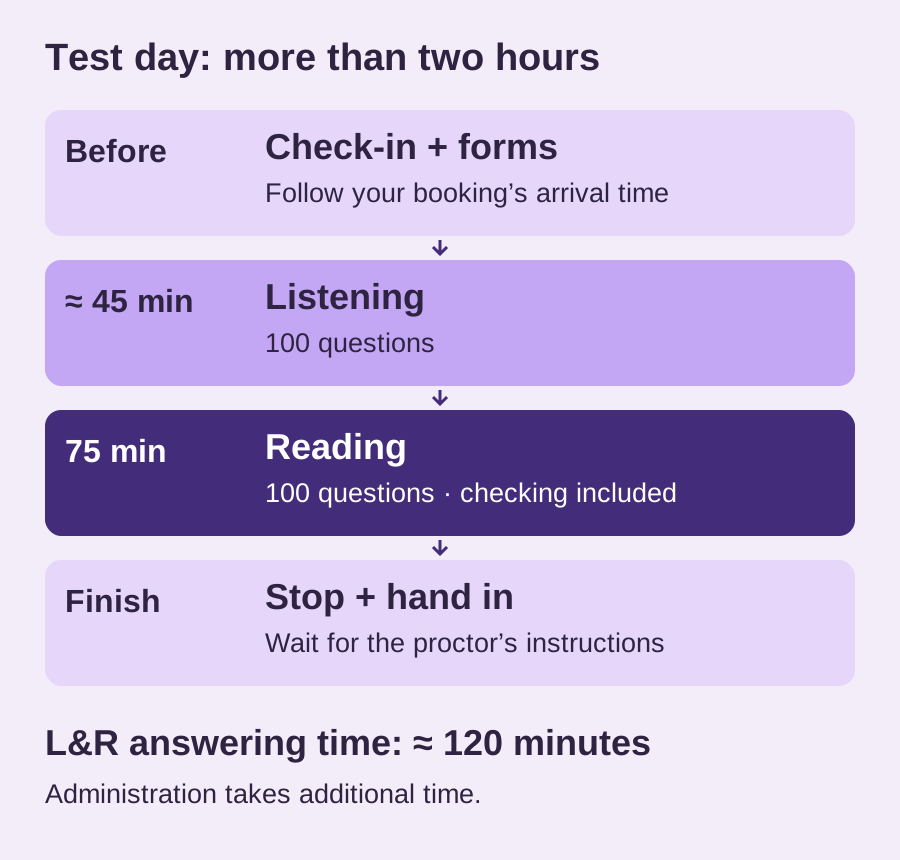
Confirm arrival, permitted watches and time announcements with the administrator in your country.
Official timings and question counts
The time limits apply to whole sections, not separately to every row. ETS’s examinee handbook gives the following:
| Section | Part and task | Questions | Official time | Source |
|---|---|---|---|---|
| Listening | 1: photographs | 6 | About 45 minutes for Parts 1–4 combined | ETS |
| Listening | 2: question–response | 25 | Same section; 100 questions total | ETS |
| Listening | 3: conversations | 39 | Same section | ETS |
| Listening | 4: talks | 30 | Same section | ETS |
| Reading | 5: incomplete sentences | 30 | 75 minutes for Parts 5–7 combined | ETS |
| Reading | 6: text completion | 16 | Same section; 100 questions total | ETS |
| Reading | 7: reading comprehension | 54: single passages 29, multiple passages 25 | Same section | ETS |
That page does not set separate time limits for Parts 5, 6 and 7. Keep the official specification separate from your own pacing checkpoints.
A 75-minute Reading budget
Our editorial starting allocation is 10 / 8 / 57 minutes. Part 7’s 57 minutes includes checking answer positions; it does not mean 57 minutes of reading plus extra checking time.
| Part | Questions | Suggested minutes | Warning that you are overspending |
|---|---|---|---|
| 5 | 30 | 10; move on at 10 minutes elapsed | Comparing the same choices without gaining evidence |
| 6 | 16 | 8; move on at 18 minutes elapsed | Choosing from the blank alone, then rereading for context |
| 7 | 54 | 57, including checking; finish by 75 | Searching the same documents again after finding the evidence |
| Total | 100 | 75 | Leaving a batch of answers to transfer at the end |
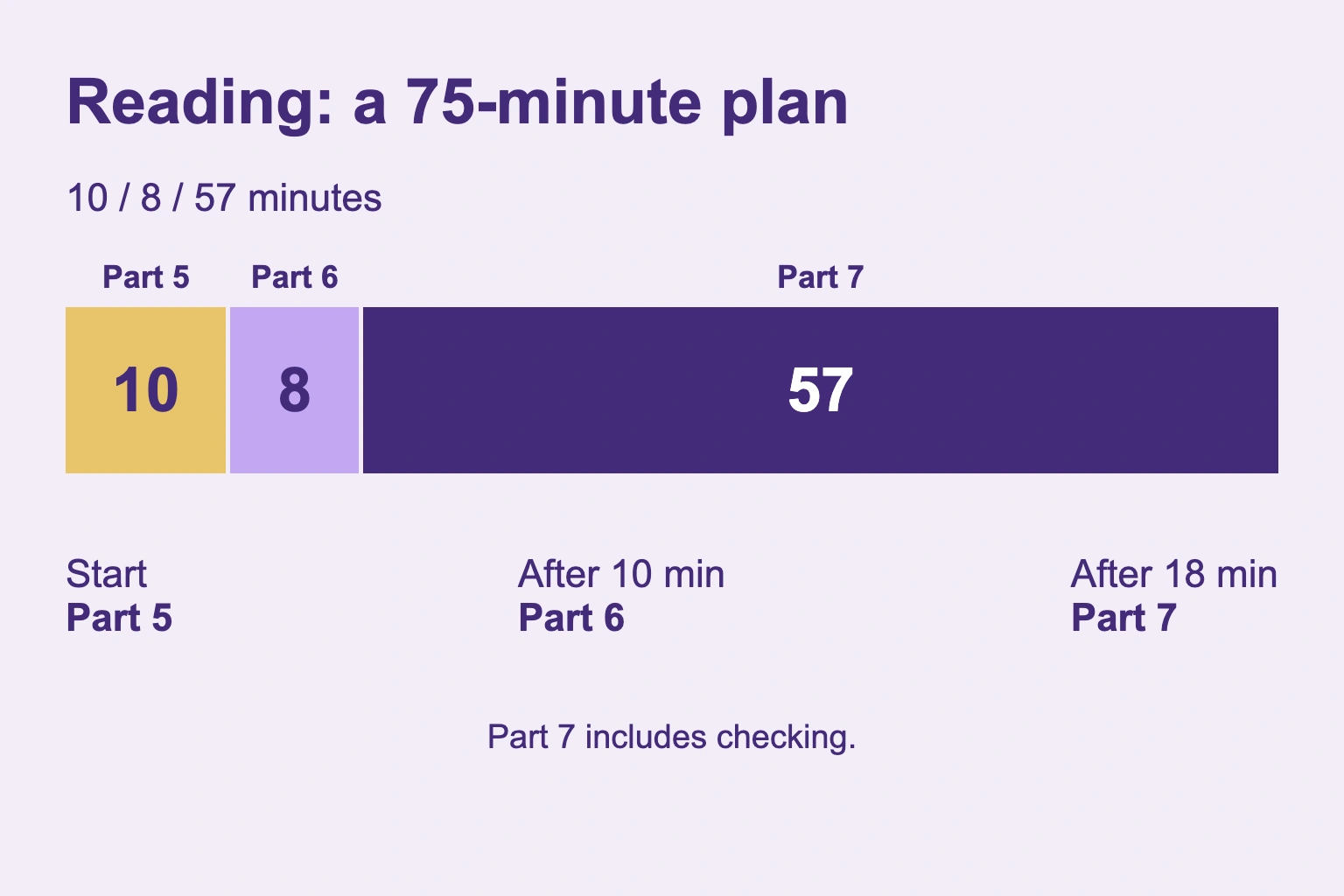
During practice, record where you are at 10 and 18 minutes. On test day, calculate those checkpoints from the actual Reading start and follow the proctor’s instructions.
Do not choose a budget from your target score alone. If a ten-minute Part 5 causes accuracy to collapse, diagnose vocabulary or grammar and trial a different allocation; record the corresponding reduction in Part 7 time. Equal seconds per question are also a poor starting assumption because grammar decisions and cross-document comparisons require different work. Keep the broader schedule in the TOEIC study-plan guide.
For interpreting a target score, see TOEIC scores and levels.
Part 5: keep 30 questions from taking over
Official format: 30 incomplete sentences, each with four choices. ETS. Why time disappears: circling between similar options when you do not know what evidence could distinguish them.
Practice: time the whole Part, then label long pauses as word form, vocabulary/word combinations or sentence structure. Explain what would have let you decide, rather than memorising the correct letter. Vocabulary-resource selection belongs in the TOEIC vocabulary-book guide.
Test-day decision: if another reading adds no evidence, avoid spending indefinitely on that one question. Ten minutes is a checkpoint for the whole Part, not an identical deadline for every item. If you leave an answer blank temporarily, check the next question number against its answer field.
Part 6: use context without repeatedly starting over
Official format: 16 questions, four per text; options can be a word, phrase or whole sentence. ETS. Why time disappears: deciding from the immediate blank, then backtracking when the next sentence does not fit.
Practice: time each text and distinguish grammatical evidence from contextual evidence. Explain pronoun references and how the inserted sentence continues or changes the topic. Do this in a separate review session rather than pausing the timed attempt.
Test-day decision: read the context you need, choose and move through the text. If you pass the 18-minute Reading checkpoint, reassess the remaining work instead of adding a succession of “just one more minute” extensions.
Part 7: separate reading from finding evidence
Official format: 29 questions on single passages and 25 on multiple passages; some ask where a sentence belongs. ETS. Why time disappears: either understanding the English is slow, or you understand it but keep searching for the answer again.
Practice: time each document set. Afterward, identify whether the delay was understanding the text, comparing options or locating evidence. Try text-first and question-first reading on different unseen sets, comparing accuracy as well as time. Do not select a method merely because it felt faster.
Test-day decision: once you have adequate evidence, do not reread every line just for reassurance. For multiple documents, track who requested what and where a reply changed the original information. Matching a familiar word alone is not enough; keep necessary comparisons.
If you reach Part 7 at minute 25, you have already lost seven minutes against our trial plan. First examine Parts 5–6. If you enter at minute 18 but stall, examine Part 7 itself. Log the entry time, questions reached by minute 75 and answers correct within time. Finishing everything is not the only measure of success.
Practise with official TOEIC materials
Start with the free TOEIC Listening & Reading Sample Tests linked on ETS’s preparation page to learn the question types. The same page offers the TOEIC Official Learning and Preparation Course Online through local EPN offices. For a 75-minute measurement, choose a complete unseen Reading practice test; a short sample only rehearses the format.
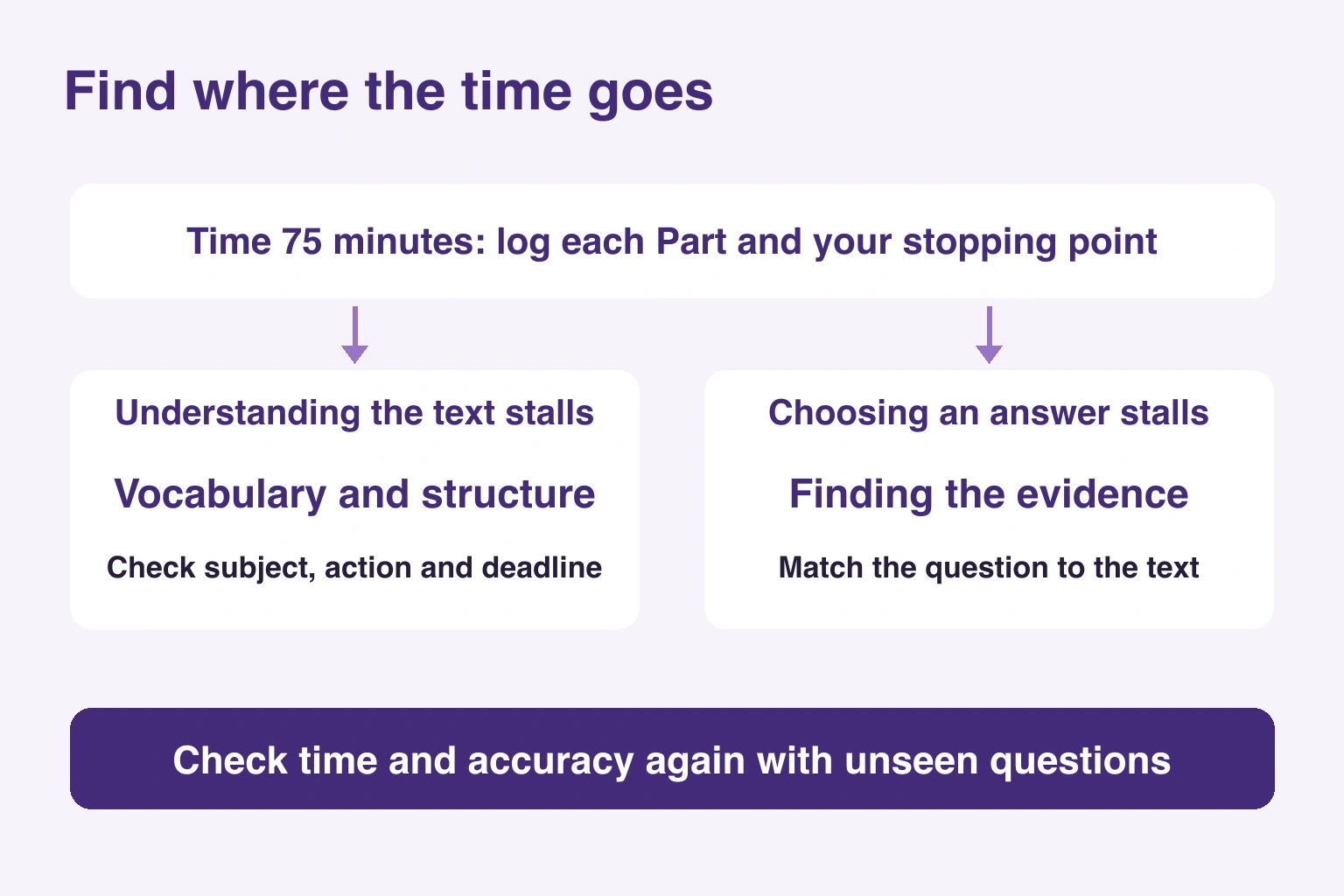
- Stop at 75 minutes. Use an unseen Reading test. Record the Part transitions and stopping point. Work on unfinished questions afterward in a separate session, keeping timed and untimed results separate.
- Log the cause, not every second. Part times and a short explanation of long pauses are enough to choose a repair task.
- Repair the right problem. If meaning remains unclear without a time limit, check vocabulary and structure. If the text is understandable but choosing is slow, compare the question with the evidence.
- Retest on unseen material. Repeated questions check whether you understand the explanation; remembered answers do not establish faster first-time reading.
| Fictional log | Observation | Next check |
|---|---|---|
| Part 5: 13 minutes | Two vocabulary questions repeatedly reconsidered | Unknown meaning or wrong interpretation? |
| Part 6: 10 minutes | Backtracking at sentence insertion | Pronoun and sentence connections? |
| Part 7: 52 minutes | Final set unreached | Earlier overruns or slow understanding/evidence search? |
| Untimed follow-up | Solvable with extra time, or still unclear | Method practice or language repair? |
A single document set fits into a work break, but schedule a complete 75-minute attempt to check whether your pacing holds across all three Parts.
A workplace sentence: capture the action and deadline
Our editorial team wrote this workplace sentence:
Please submit your travel receipts by Friday afternoon.
The request is to submit travel receipts, by Friday afternoon.
If “receipts” stopped you, check vocabulary. If you overlooked “by Friday afternoon”, check how you track deadlines. After confirming meaning, listen, read aloud and briefly state what is requested. Speed alone is not the goal: retain both the task and its deadline. Combine sentence review with timed unseen Reading practice.
Bring the deadline back from memory
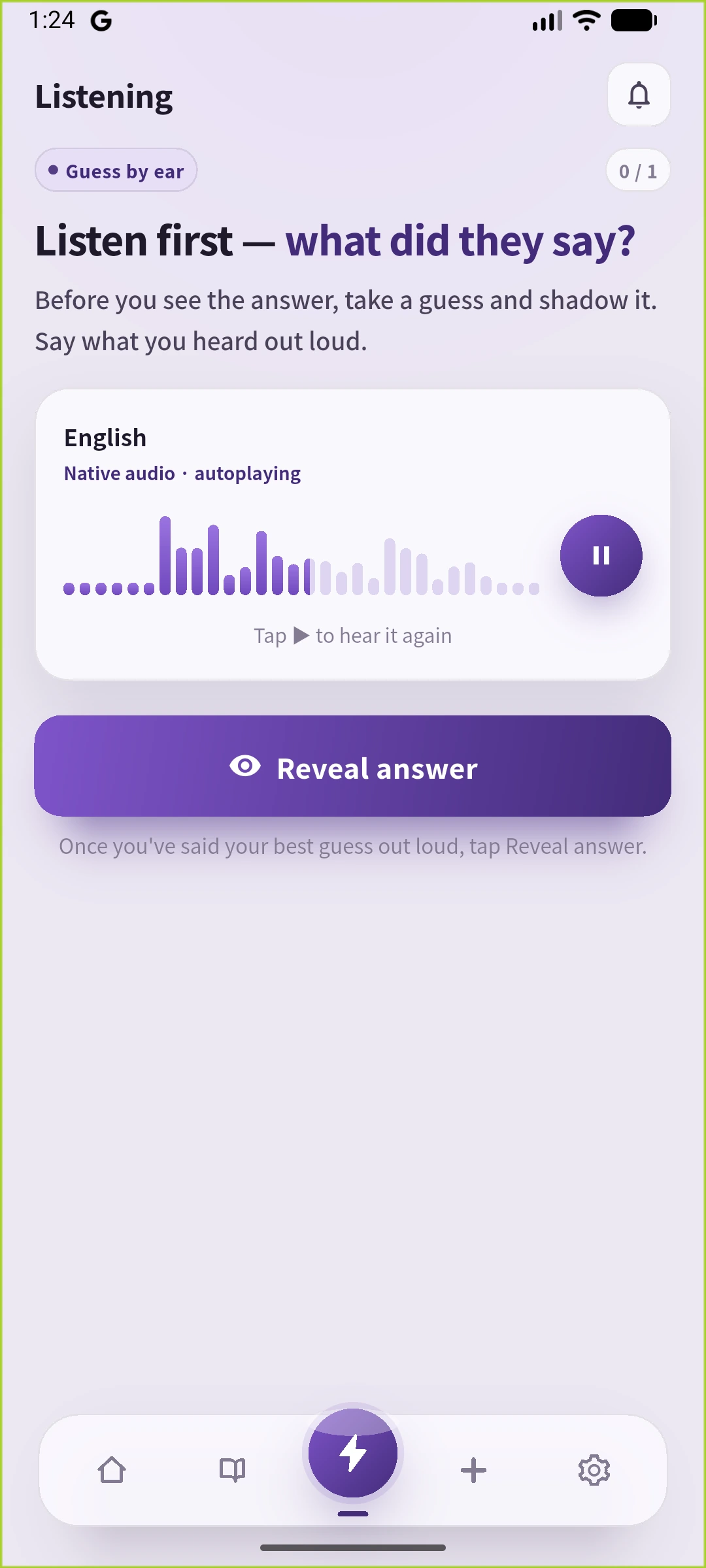
In our app SpeakGain, the Listening card keeps this sentence hidden while its audio plays. Try answering two questions aloud before revealing it: what must be submitted, and by when? Then use Reveal answer to check whether you kept “travel receipts” and “Friday afternoon” together.
Try the receipts sentence
Listen once, then say the request with its deadline.
Listening preview: preserve attention to the audio
You follow the recording; you cannot finish Listening early and transfer spare time to Reading. Learn the purpose of Directions from the official samples beforehand; we do not reproduce them.
Part 1: six photograph questions
Format: four descriptions played once, not printed. ETS. Delay: mentally replaying a missed word. Practice: notice people, objects and actions, then listen and check the transcript afterward. On the day: return attention to the next recording rather than carrying an old uncertainty forward.
Part 2: 25 question–response items
Format: a question or statement and three responses, played once and not printed. ETS. Delay: continuing to reconstruct a phrase. Practice: review what was asked and why the response fits. On the day: there is no printed question to preview; attend to the current audio.
Part 3: 39 conversation questions
Format: three questions per conversation with printed questions/choices; some use visual information. ETS. Delay: reading options while missing the opening. Practice: try previewing only the question’s purpose—place, purpose or next action. On the day: turn back to listening when the recording starts.
Part 4: 30 talk questions
Format: three questions per talk with printed questions/choices. ETS. Delay: trying to finish reading everything and missing the audience or topic. Practice: compare no preview, questions only and questions plus choices on different unseen sets. On the day: use only an amount you practised without losing the audio.
Preview is not compulsory in our view. Reduce it if it interferes with understanding. Broader diagnosis belongs in improving English listening. Looking at or answering Reading during Listening, or vice versa, is prohibited. ETS rules.
When time is running out
Stop answering when the proctor calls time. The ETS handbook requires answers on the answer sheet and prohibits working on a different section from the one being timed. Keep question numbers aligned as you move.
Check that question and answer-field numbers match. Avoid giving all remaining time to one item that yields no further evidence. ETS scoring guidance says wrong answers are not penalised and recommends choosing one option when unsure; this is not evidence for a lucky-letter pattern. Make any remaining choices within the permitted time. We would not plan on transferring a large batch at the end.
FAQ
How long is the TOEIC test?
L&R answering time is about two hours. ETS allows about 2½ hours with the questionnaire; use your booking’s arrival and finish instructions when planning the visit. Speaking & Writing is a separate test.
How many minutes per Reading Part?
Try 10, 8 and 57 as a starting point. Only the overall 75-minute Reading limit is official; checking is included.
What if Part 7 never gets finished?
Check when you enter it. Diagnose earlier overruns separately from slow understanding or evidence search within Part 7.
Must I preview Listening questions?
No. Try a manageable amount for Parts 3–4, reducing it if you miss the audio. Part 2 has no printed question or options.
Can I start Reading with Part 7?
The official pages inspected do not specify the answering order within Reading. That is not a claim that starting at Part 7 is faster. Rehearse on unseen material, including answer-field alignment, and follow test-day instructions. Never cross section boundaries.
Should I fill random answers at the end?
We do not recommend a particular filling pattern. There is no wrong-answer penalty, but answer only within time and stop as instructed. Avoid number shifts and late bulk transfer.
How many times should I repeat the book?
No repetition count guarantees finishing. Use familiar questions to review reasons and unseen questions to check timed performance.
Your next timed attempt
Use a budget to expose where you stall. Trial 10/8/57, log transition times, timed correct answers and the cause of hesitation, then change one problem at a time. Keep accuracy in view and adjust within the official 75 minutes and test rules.