
What is PROGOS? Test format, timed answers and B1 vs B2
Published Updated
PROGOS is a roughly 20-minute, AI-scored business English speaking test offered by PROGOS Inc., a RareJob Group company. It is used by employers and reports overall speaking ability in nine CEFR-based bands, from Pre-A1 to B2 High and above; your employer decides which result it requires. Start preparation by recording one 20-second answer to a workplace question, then check whether your first sentence actually answers it. The provider’s overview explains the service; the result manual explains its reporting scale.
If you work for a Japanese company or are applying to teach English online, check the test invitation and submission deadline before choosing the app or browser route. Below are original workplace exercises with full answers, preparation notes and a comparison of two ways to develop the same idea.
Format: five parts in about 20 minutes
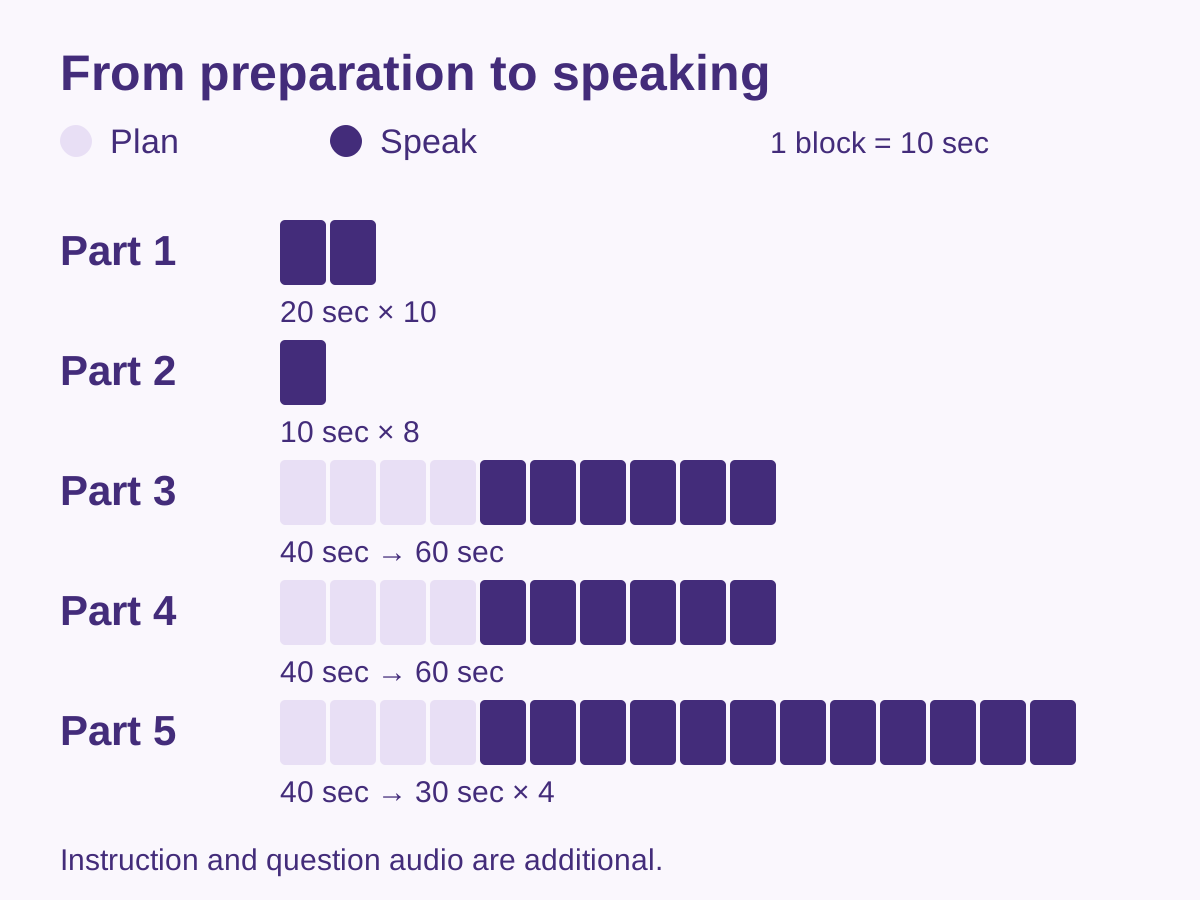
The official samples specify these limits. Allow extra time for the login and equipment checks in the test-taking procedure.
| Part and task | Count and timing |
|---|---|
| 1 Interview: answer a spoken question |
10 Prepare: None Speak: 20 seconds each |
| 2 Read the displayed text aloud |
8 Prepare: None Speak: 10 seconds each |
| 3 Present a topic covering the required points |
1 Prepare: 40 seconds Speak: 60 seconds |
| 4 Explain a graph or graphic |
1 Prepare: 40 seconds Speak: 60 seconds |
| 5 Role-play |
One situation, four responses Prepare: Initially 40 seconds Speak: 30 seconds each |
The overview calls Part 5 four questions, whereas the sample calls it one question including related questions and describes four response rounds. Count the four turns within one situation. Part 1 questions are audio-only; Part 2 displays the text to read.
Part 1: three different questions, three direct openings
Use the first sentence to supply the requested time, past event or reason. The examples below contain about 30–40 words each. Word counts describe these exercises, not a test requirement: use a 20-second timer at your own speaking pace.
A time: When would you schedule a short training session?
32 words
I would schedule it for Thursday afternoon, after our weekly orders have gone out. Most colleagues are available then, and we could spend the final ten minutes trying the new tool together.
A past change: What did you change about your workspace recently?
33 words
Last month, I moved our shared printer closer to the packing desk. People used to walk across the room for every label. Now they can collect labels while checking the boxes beside them.
A reason: Why do you prefer written meeting notes?
35 words
Written notes help me check decisions after a busy meeting. I sometimes miss a date when several people speak at once. A short summary gives everyone the same deadline and makes responsibilities easier to remember.
Replay your recording once. For the first question, can you hear a specific day? For the second, did you describe a completed change? For the third, did you explain the preference? Then change the prompt and answer without reading.
Part 2: read the instruction as it stands
Read this original practice sentence within ten seconds:
16 words
Keep the spare labels beside the printer so that the packing team can find them quickly.
Keep so that connected to the purpose of the instruction, and make spare labels clear. Compare your recording with the displayed text for missing words. A personal opinion belongs in other tasks; here the job is accurate reading.
Part 3: a complete proposal in 60 seconds
Practice task: propose a change to your shipping process. Explain the problem, the new procedure and how you will evaluate it.
Use the 40 seconds to write a small map: 0–10 seconds: identify the three requirements; 10–25: assign “address / sales check / two-week trial”; 25–40: choose the opening and final decision. Avoid drafting sentences during preparation.
116 words
Our main goal this quarter is to reduce delivery delays. I propose a short address check before the packing team prints any labels. At present, unclear addresses sometimes reach the warehouse, and staff have to stop packing while they contact the customer. Under the new process, the sales assistant would check incomplete addresses each morning and mark confirmed orders in our shared list. The warehouse could then pack those orders without another phone call. We would try this with one product line for two weeks, counting how many parcels leave on the promised day. If the trial saves time without adding too much work for sales, we could extend it to the rest of our orders.
The answer develops all three points: a concrete interruption, who will do what differently, and a way to judge the trial. When recording, aim to reach the trial by about 40 seconds so there is time for the final decision. If you run long, shorten the background before cutting a required point.
Part 4: explain a change while keeping the totals straight
Practice data: customer enquiries by channel, counted over three weeks. All numbers below were created for this exercise.
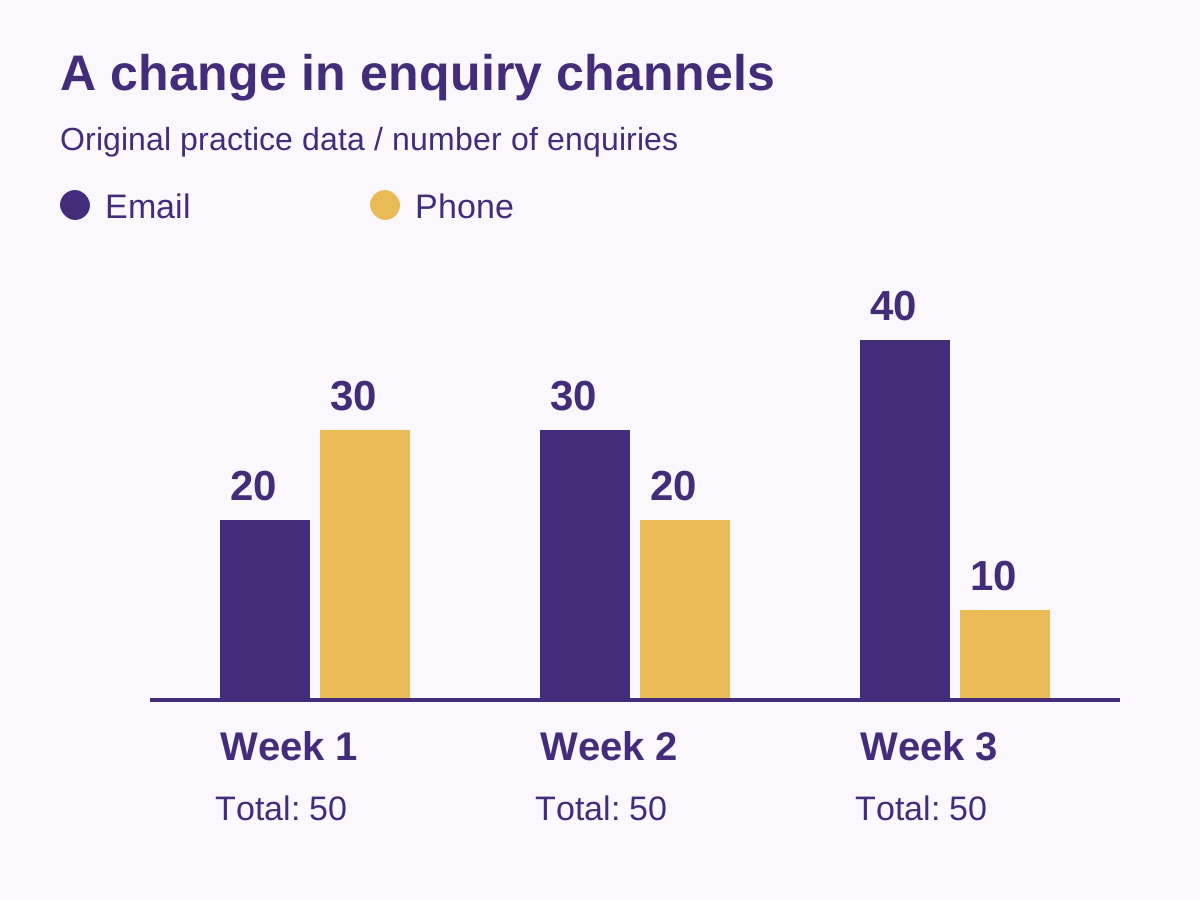
Preparation, 40 seconds: 0–10: read the title, units and weeks; 10–25: note “email up / phone down / total 50”; 25–40: select the first-to-last comparison and a closing observation.
113 words
The chart compares customer enquiries received by email and phone over three weeks. Email enquiries rose steadily, from twenty in week one to thirty in week two and forty in week three. That is an increase of twenty overall. Phone enquiries followed the opposite pattern, falling from thirty to twenty and then ten. The total remained at fifty enquiries every week, but the main channel changed. Phone was ahead by ten in the first week, while email was ahead by thirty in the last week. By week three, email accounted for four fifths of all enquiries. The chart shows a shift towards email, but it provides no information about what caused that shift.
Notice the difference between an increase of twenty and an increase to twenty. Check every spoken figure against the chart, including “four fifths”: 40 of 50 enquiries. There is no need to invent a campaign or a staffing change to explain the pattern.
Part 5: finish all four turns of one conversation
Situation: your workplace is changing its delivery entrance on Monday. You and a colleague must notify a supplier. In the initial 40 seconds, note the change, the people who need the information and one backup channel. Listen to each new question before selecting your response; each turn has its own 30-second limit.
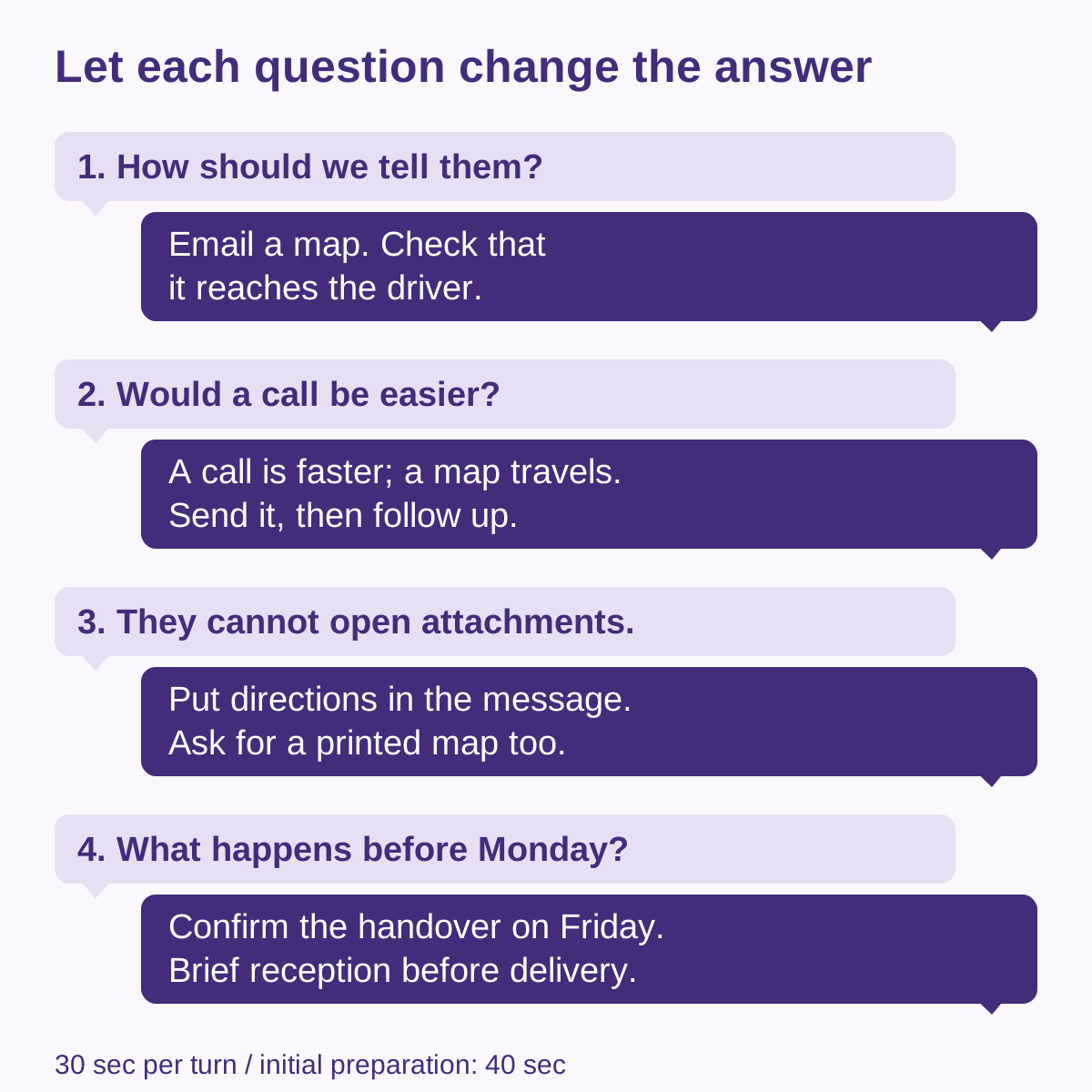
Turn 1: How should we tell the supplier about our new delivery entrance?
50 words
I would email a marked map today and ask the supplier to confirm that the driver has received it. The entrance changes on Monday, so a written message gives them time to update their delivery instructions. I would include our reception number in case the driver needs help on arrival.
Turn 2: Would a quick phone call be easier?
50 words
A call would be faster if we needed an immediate answer, but the driver might not be the person who answers the phone. A map can be forwarded directly and checked during the journey. We could call after sending it to make sure the supplier knows this change is important.
Turn 3: The supplier says the driver cannot open attachments. What now?
52 words
In that case, I would put the directions in the email itself, using the street name and the colour of the new gate. I would also ask the supplier to print the map for the driver. That gives the driver a paper copy and simple directions to follow without opening an attachment.
Turn 4: What will you do before Monday’s delivery?
49 words
On Friday, I will check that the supplier has passed on both the map and the written directions. I will tell reception the expected arrival time and give them the supplier’s contact number. If the driver still reaches the old entrance, reception can explain the route before unloading begins.
The final response assigns actions and a fallback. Practise again with a different obstacle, such as an earlier delivery time, so that you have to respond rather than recite.
B1 and B2: compare the development of the same answer
The Council of Europe Global Scale describes B1 as connecting familiar ideas and giving brief reasons for opinions or plans. B2 includes clearer detail and discussion of the advantages and disadvantages of options. Here is one practical way to see that difference in content development. These examples illustrate descriptors; a level judgment requires a broader sample of what a speaker can do.
Shared question: Would you give new staff a printed checklist or online instructions?
A B1-shaped answer: a preference, a reason and an experience
40 words
I would give new staff a printed checklist. It is easy to keep beside the desk, and they can tick off each task. I used one when I joined the team, and it helped me remember the first day’s jobs.
A B2-shaped answer: detail, a trade-off and a workable choice
81 words
I would give new staff a printed checklist for their first day, although an online version is easier to update. Paper lets them check routine tasks without switching screens; for example, they can follow the equipment setup steps beside their laptop. Its drawback is that an old copy can quickly become misleading. I would therefore print the date on each checklist and link it to the current online instructions, combining a convenient starting point with a reliable source for later changes.
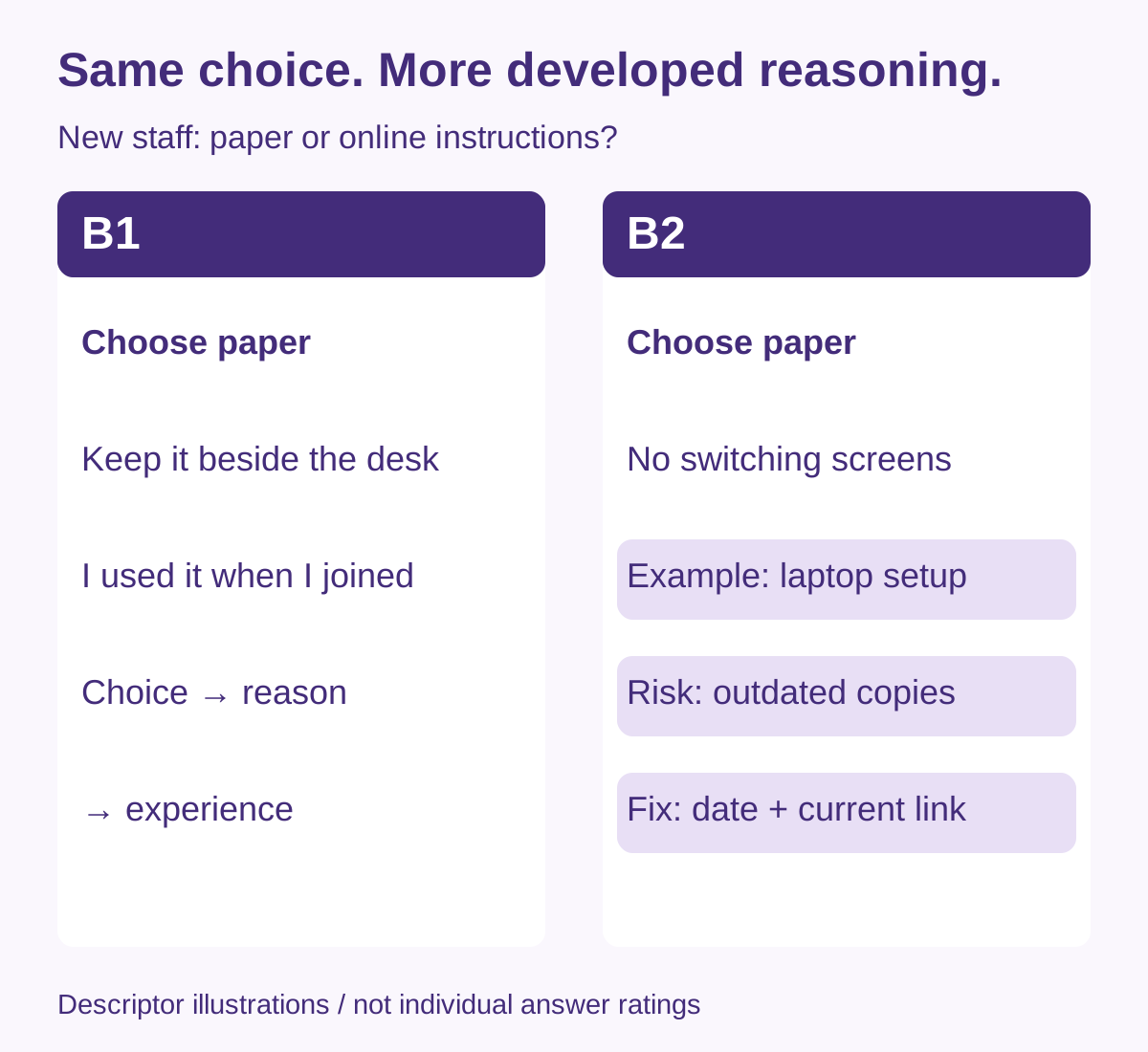
The second answer keeps the same position but explains when it works and how to manage its drawback. Try adding one limitation and one response to that limitation to your own answer. Keep them relevant to the question.
Reading your PROGOS result
The nine overall labels are Pre-A1, A1, A1 High, A2, A2 High, B1, B1 High, B2, B2 High and above, as shown in the official level material. The last label groups the upper range together.
The six categories are Range, Accuracy, Fluency, Interaction, Coherence and Phonology. Read them as feedback on the breadth of expression, correctness, flow, interaction, connected organization and sound. The feedback manual also says the overall evaluation considers task achievement and how well the response answers the question. Use the report’s advice to choose one recording check: for example, consistently using past tense for a past change.
Test access, devices and price
For a company-arranged test, use the organization’s URL, obtain an emailed access code, select the test and complete registration and equipment checks. The official process explains the sequence. Your organization may control whether you can see the result, as described in the My Page guidance.
The published browser-test price is ¥1,100 per attempt, including tax. Both the overview’s pricing section and the individual-app page show that amount. The overview’s FAQ still says ¥550, so check the charge in your organization’s booking terms. The individual app currently offers the test free, with paid conversion planned at an unspecified date. Its current landing page does not state a daily attempt limit; check the in-app allowance before planning repeated attempts.
The supported-environment list covers PCs, smartphones and tablets for automatic scoring; online monitoring requires a PC. Match your device, OS and browser to that list, and run the microphone and speaker checks on the connection you will actually use.
The guidelines specify timed progression, no pausing and one playback of the question audio. If interrupted, the FAQ describes restarting from the first question of the interrupted part. It separately says completed attempts generally cannot be retaken, except where the operator recognizes a fault. Contact the administrator with the problem and time rather than assuming a new attempt is available.
A three-week plan around one correction a day
Reserve 15 minutes: 2 to inspect the task, 5 to speak and record, 5 to listen, and 3 to change one thing and record again. Keep the original and revised recording so you can hear what changed. Only record your practice exercises: the test FAQ prohibits copying or recording actual test questions.
| Week | Practice and check |
|---|---|
| 1 | Try all parts, then focus on short answers and reading Check: Does the opening match the question? Did I preserve the text? |
| 2 | Alternate proposals and charts with separate preparation timers Check: Did I cover each point and state the numbers correctly? |
| 3 | Role-play with changing constraints, then rehearse weaker tasks Check: Did I respond to the latest question within its limit? |
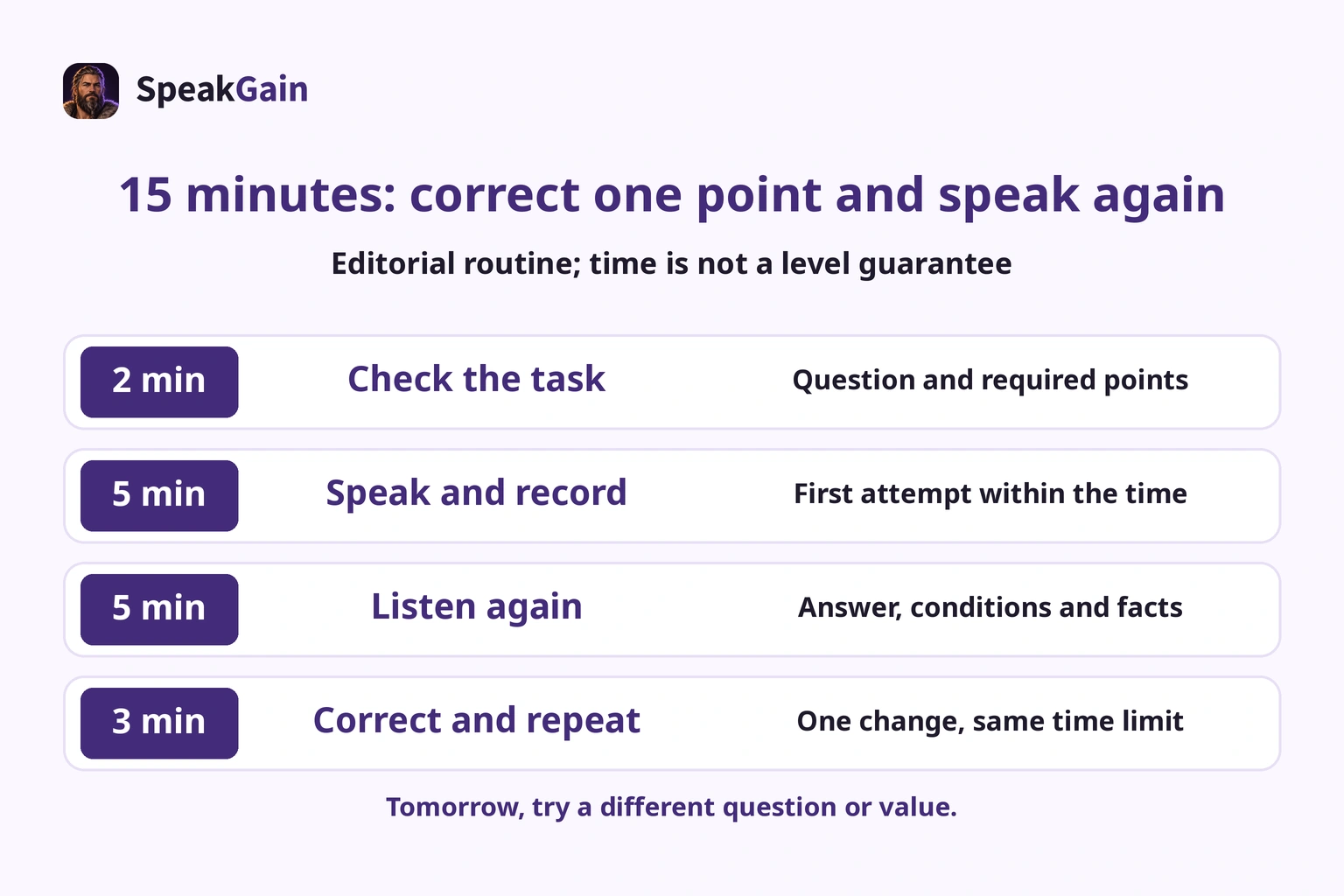
With only a week available, choose the two problems that interrupt your answers most often. Leave the final session for the invitation, deadline and equipment. For additional solo exercises, see ways to practise speaking on your own.
Approaches to leave out
Avoid learning a whole answer as a fixed script: a question about timing can easily become one about reasons. Repeated filler also spends time without helping the listener. The official FAQ identifies irrelevant responses as a scoring problem. Reuse a short phrase only after deciding what this question needs.
Rehearse the difficult sentence, then restore the whole answer
Suppose the opening of the shipping proposal keeps breaking at this quarter. Save “Our main goal this quarter is to reduce delivery delays.” as one practice card in our app, SpeakGain. The smaller unit lets you focus on that transition before trying the entire proposal again.
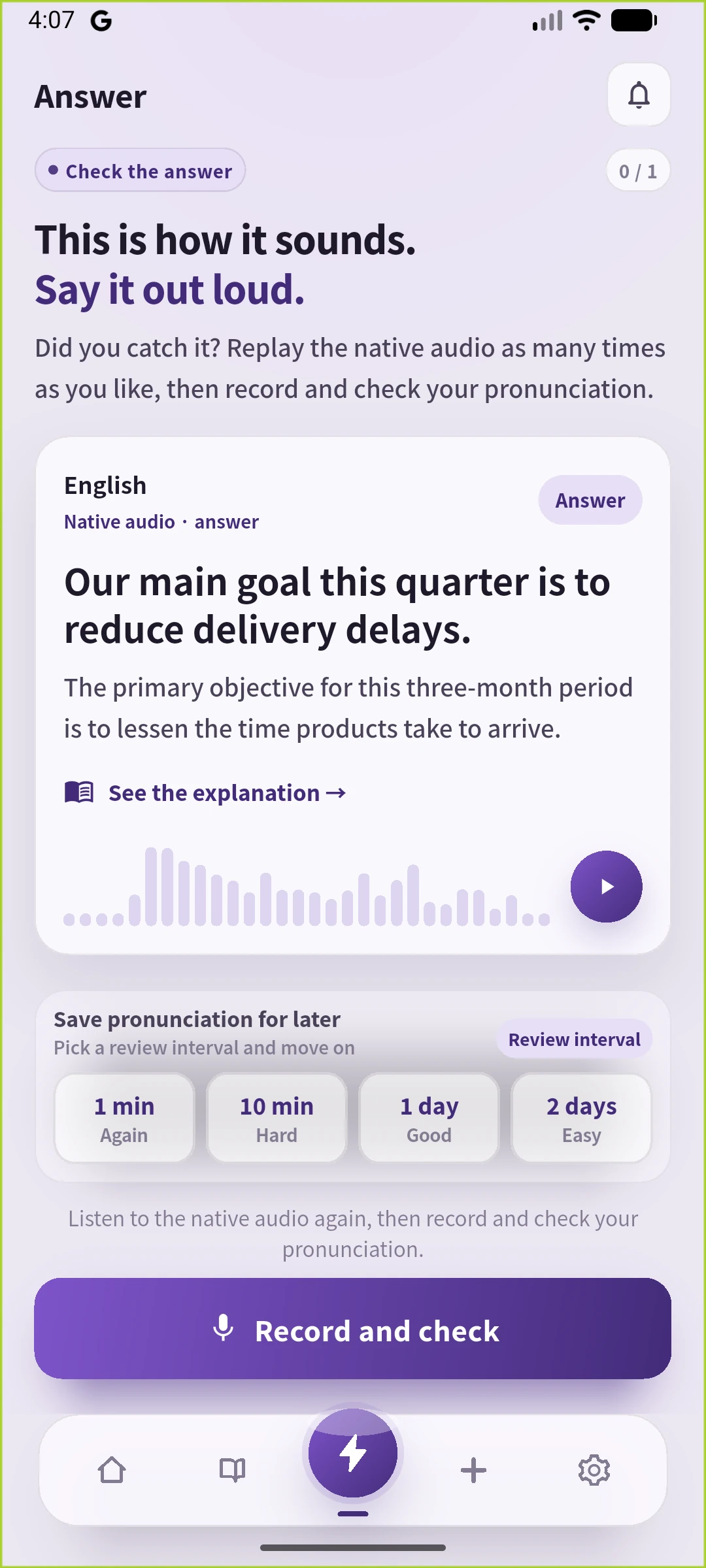
Listen with the sentence hidden, say it from memory, then reveal it to check the words you dropped. This existing English-interface capture shows the listening state used for the same card:
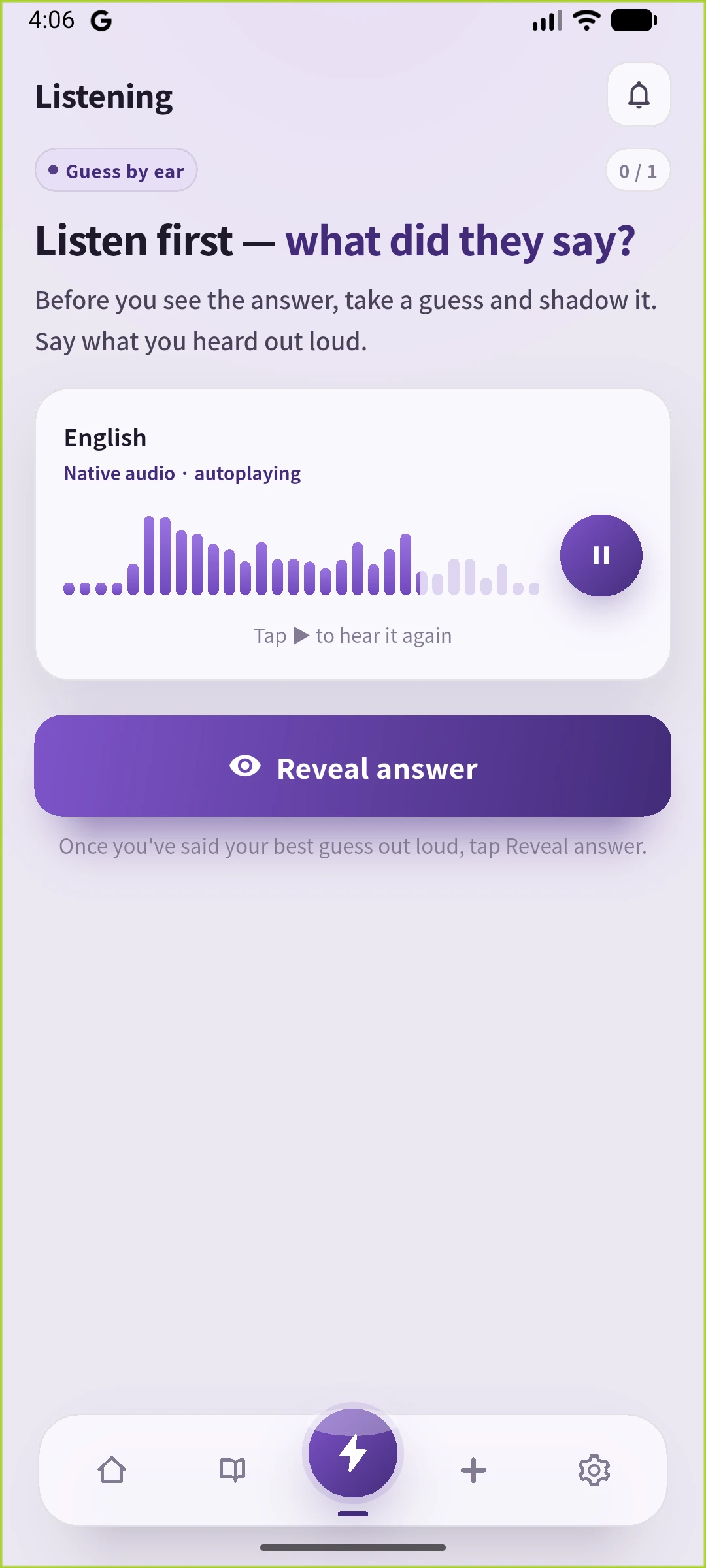
For a quick listening pass here, play the saved card’s synthesized voice:
Return to the 60-second proposal and add the address-check procedure immediately after the opening. The useful check is whether the practised sentence now connects smoothly to your next idea.
PROGOS, TOEIC Speaking and Versant: check the requested result
An employer’s accepted test and submission route decide which result you need. The official guides describe these durations and reports:
| Test | Duration and report |
|---|---|
| PROGOS | About 20 minutes Nine overall bands and six categories |
| TOEIC Speaking | About 20 minutes 0–200 |
| Versant Speaking and Listening | 17 minutes Pearson GSE and CEFR reporting |
For the different response tasks, see our Versant preparation guide. Use each test’s own instructions when practising.
FAQ
What does PROGOS mean for my job application?
It is a business English speaking assessment. Ask the recruiter for the required band and accepted test route; the official report gives both overall and category feedback.
Is PROGOS free?
The individual app currently offers free testing and announces a future move to paid use. The published browser-test price is ¥1,100 including tax. For the pricing-page discrepancy and daily allowance, see the test-access section above. Confirm whether your employer accepts app results.
How do B1 and B2 answers differ?
In the checklist example above, the first answer connects a choice to a reason and experience. The second adds a concrete benefit, a drawback and a way to handle it. That comparison applies the CEFR descriptors to content you can practise developing.
Can I take it on my phone?
Automatic scoring supports phones, subject to the listed OS and browser requirements. Online monitoring uses a PC.
What should I practise first?
Record one of the 20-second questions above. If the first sentence misses the question, fix that before adding length. If it answers clearly, add one relevant detail and try again within the same limit.
Make the next recording specific
Pick one question, hide the example and answer with a timer. On playback, choose a single edit you can describe precisely, such as adding the time of the training session or correcting the chart’s unit. Keep that edit when you change the topic tomorrow.
Sources and currency
Official information was checked on 12 November 2026. The test samples supply the task limits, the administration manual covers interruptions, and the CEFR Global Scale supports the comparison of answer development. The exercises and graphics are written for this article.