
When English Words Won’t Come Out: Practise One Real Sentence at a Time
Published

When you know what you want to say but the English will not come out, separate what you do during the conversation from what you practise afterwards. In the moment, buy a few seconds, reduce the idea to its simplest meaning, and say one thing with words you know. Later, choose one moment that stopped you, check one short sentence, hide it, retrieve it from the situation, and use it in a similar conversation.
The goal is not to eliminate every pause. It is to turn a real pause into the next useful sentence.
First, find where you are getting stuck
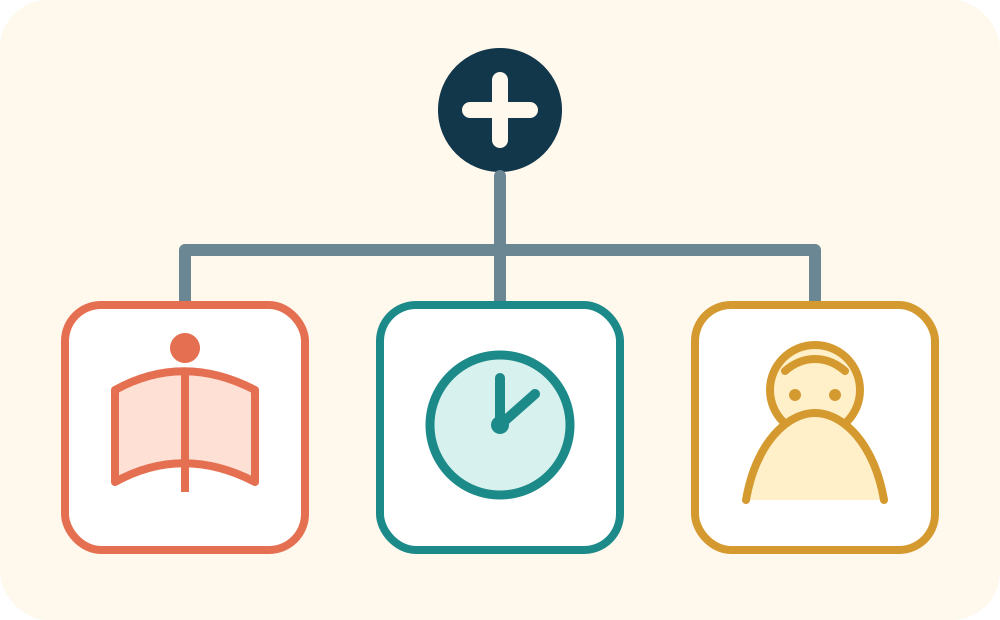
You cannot form the sentence even in writing
You may still need the vocabulary or grammar. Make the idea shorter and check a learner’s dictionary, course material, or a teacher. Speed drills cannot replace language you do not yet understand.
You can write it, but not retrieve it in time
Practise from the situation, not only from the finished answer. Before looking at the sentence, use the original question or moment as your cue and try to say it once.
You can say it alone, but freeze with another person
Pressure, listening difficulty, and deciding what to say may all be involved. Prepare a repair phrase, permission to answer briefly, and a low-pressure place to practise. Do not assume pronunciation or memory is the only issue.
During the conversation: buy time, make it smaller, communicate
Start by creating a few seconds:
Let me think for a second.
How can I put this?
Do not translate a polished sentence from your first language word for word. Keep only the main message. If “All my weekend plans fell apart, so I ended up lazing around at home” is too much, begin with:
My plans changed, so I stayed home.
The other person can ask a follow-up question. If one word is missing, explain its job or appearance:
It’s a tool you use to open a bottle.
A simple sentence that keeps the conversation moving is not necessarily the sentence you should memorise. Check it later if you are unsure whether it is natural or accurate.
After the conversation: practise one sentence you missed
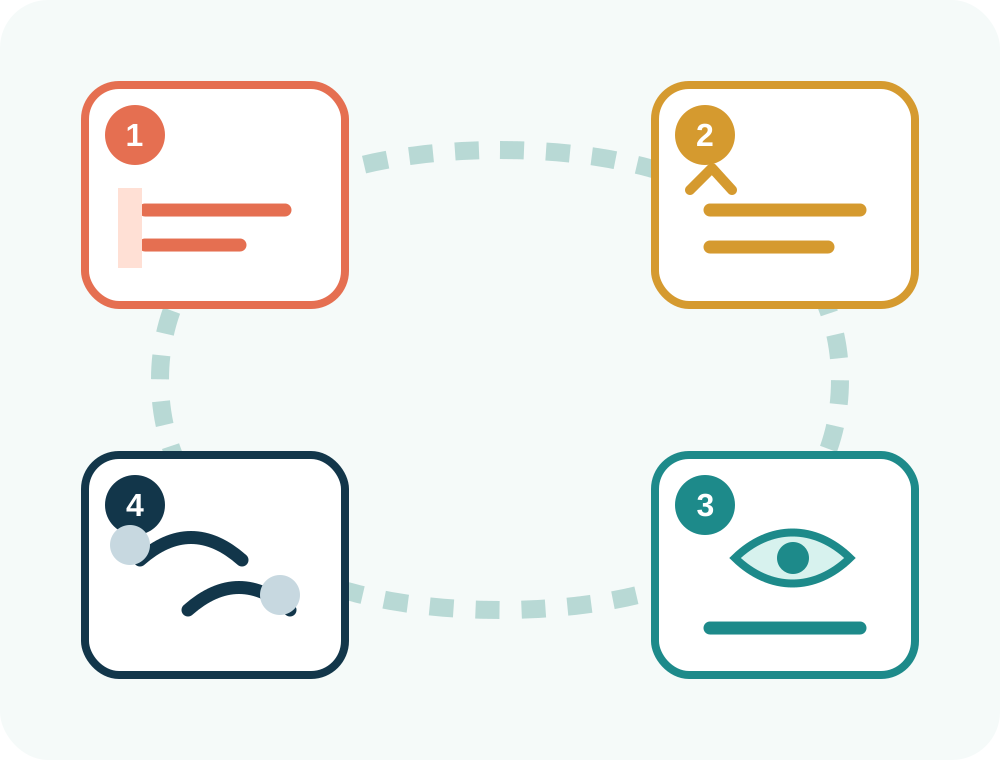
1. Save the situation and intention in one line
You do not need a transcript. Write the question and the core meaning:
Situation: I was asked about my weekend and wanted to say that my plans changed, so I stayed home.
Prioritise situations likely to return: project updates, hobbies, introductions, or questions friends often ask.
2. Check one short sentence that matches your meaning
Use a teacher’s correction, a learner’s dictionary, or reliable examples. Choose one usable sentence rather than collecting five alternatives.
My plans changed, so I ended up staying home.
If you are unsure about end up + -ing, check its meaning and examples. Do not repeatedly rehearse a guess as if it were confirmed English.
3. Hide the English and retrieve it from the situation
Look only at the situation and speak before revealing the answer. If you cannot, check the sentence, hide it again, and retry after a short pause.
Kang, Gollan, and Pashler (2013) compared imitating spoken foreign-language words with trying to retrieve each word from a picture before hearing the answer. Retrieval practice produced better comprehension and production on an immediate or two-day test without reducing pronunciation quality. The study did not test complete sentences or free conversation, but it supports putting an attempt before the model answer. Read the PubMed abstract.
4. Check the sound, then use it in a nearby situation
Listen to a dictionary, teacher, or read-aloud tool for stress and phrasing, then say the sentence again. Decide where you will use it: your next lesson, a work update, or a language exchange.
Lambert, Kormos, and Minn (2017) found changes in some immediate fluency measures when 32 Japanese learners of English repeated three oral tasks six times. This was a small study of immediate repetition. Saying the same task more smoothly does not guarantee transfer to a different topic or long-term conversational ability. Read the Cambridge Core abstract.
A five-minute routine
- One minute: choose one recent moment when you got stuck.
- Two minutes: check one short sentence and understand its chunks.
- One minute: hide it and attempt it twice from the situation.
- One minute: check the sound and choose the next place to use it.
Do not make ten consecutive repetitions the only goal. Research on spaced and massed repetition of an oral narrative task found that different fluency measures did not respond in one uniform way. There is no single perfect repetition count for everyone. Leave some time, then test yourself before looking. Read Suzuki and Hanzawa (2022).
How to tell whether the practice is helping
Look for small, observable changes:
- You begin answering the same kind of question sooner.
- You communicate the main meaning, even with different wording.
- When a word is missing, you paraphrase instead of ending the conversation.
- You use the practised sentence once in a similar real situation.
If it still will not come out, shorten the sentence and check whether the cue is clear and the language is understood. It is diagnostic information, not proof that you lack talent.
Using SpeakGain for this practice
You can follow this method with paper, notes, or any flashcard tool.
If you want to keep a sentence you selected yourself together with listening and speaking practice, SpeakGain, our own app, is another option. Add the English sentence to create a card with English audio and an AI explanation. You can listen, optionally record yourself, check pronunciation feedback, and review it again later in one place.
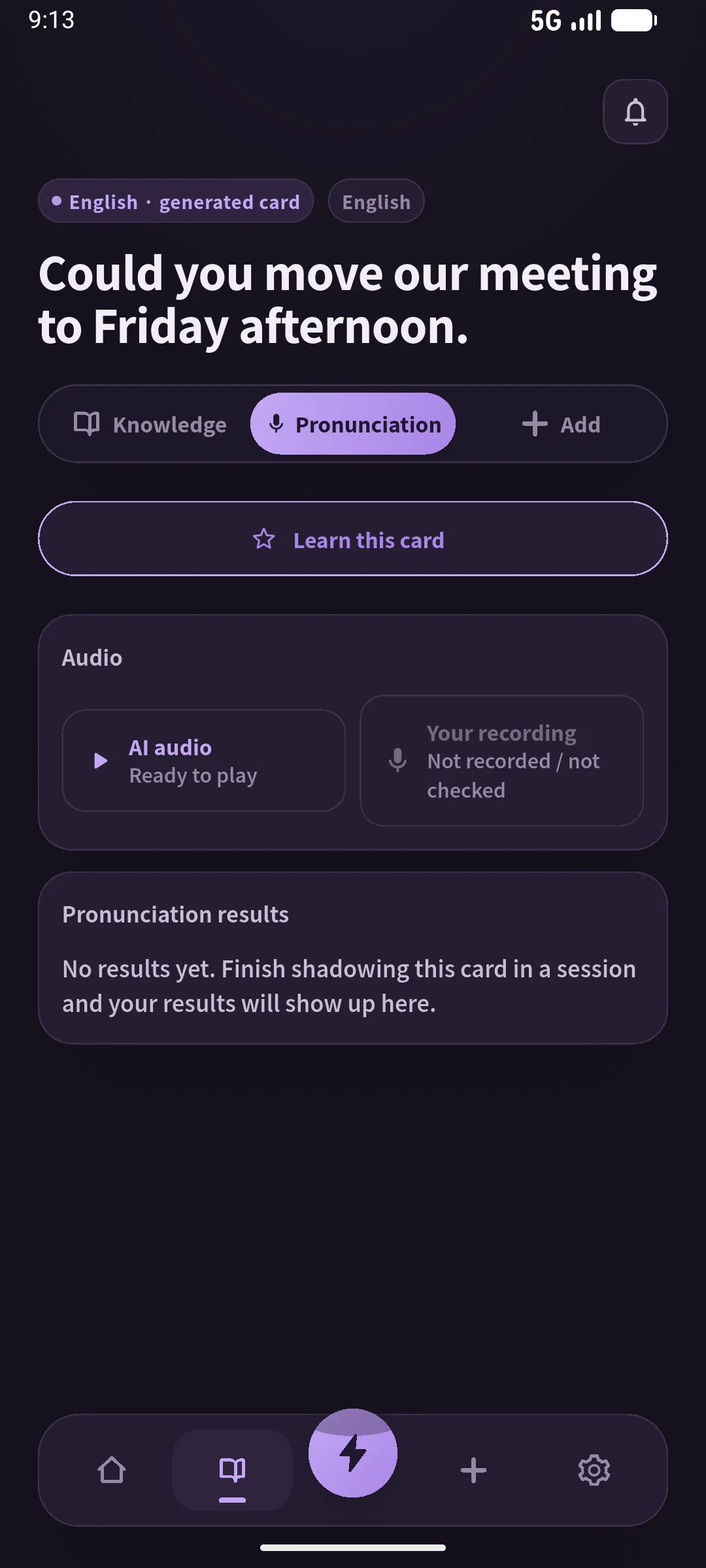
Confirm that the sentence fits your situation before saving it. Completing it in the app is not the finish line; using it in a later conversation closes the loop.
Quick answers
Will sentence-translation drills make me fluent?
They can practise forming short sentences under time pressure, but they do not guarantee free conversation. Include situations where you personally got stuck, not only textbook prompts.
What should I say when practising alone?
Choose a likely question such as “How was your weekend?” or “How is the project going?” Give a short answer, then add just one sentence.
How many sentences should I learn each day?
There is no fixed number. Start with one. Before adding more, check whether you can retrieve it days later and use it in a real situation.
Turn one pause into your next sentence
Buy time, simplify the meaning, and communicate one point. Afterwards, save one missed situation, confirm one short sentence, retrieve it without looking, and use it in a similar conversation. Start today by writing one line about the last moment when English would not come out.