
Eiken Grade 2 (Level 2): CEFR B1, passing scores and test levels
Published Updated
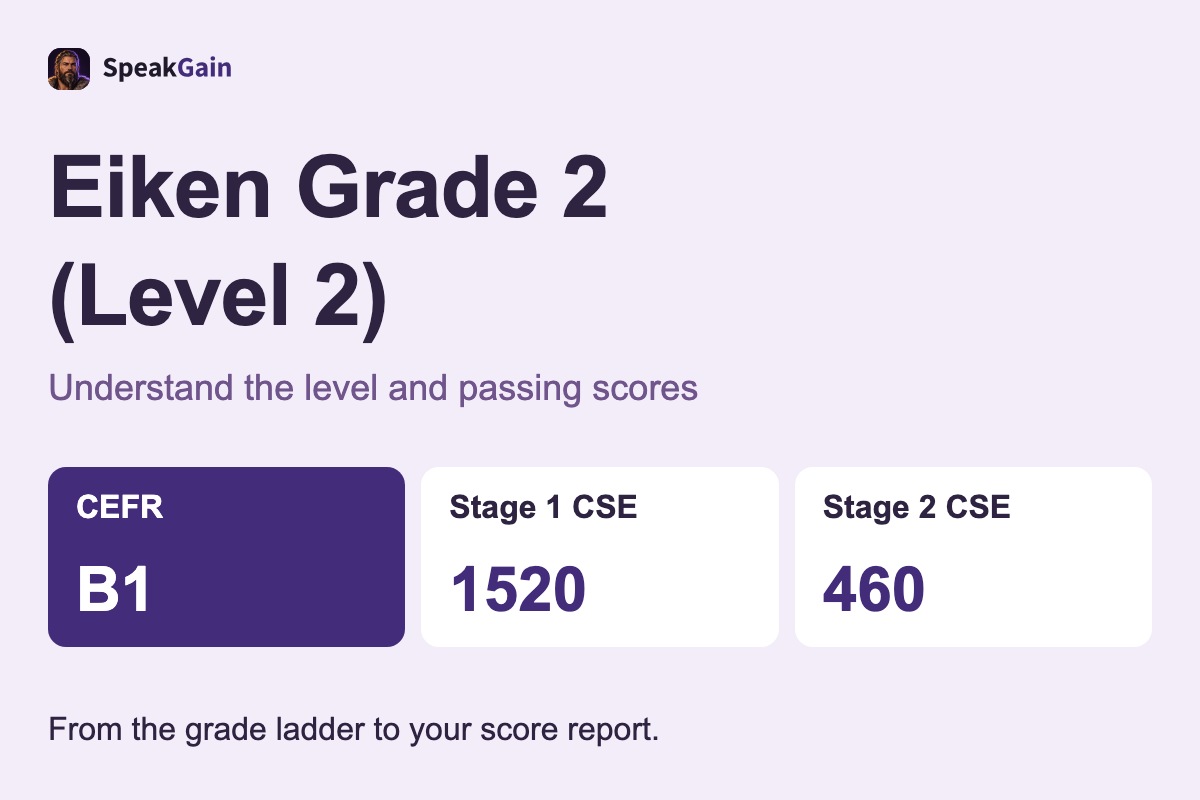
Eiken Grade 2 (often searched as “Eiken Level 2”) targets the English expected of Japanese high-school graduates and aligns with CEFR B1. Passing requires CSE1520 out of 1950 in Stage 1 and 460 out of 650 in Stage 2; around 60% in each skill is a historical preparation guideline. These figures come from the Foundation’s grade comparison and scoring explanation.
If a Japanese school application asks for “Eiken 2,” the grade is a useful starting point. You should also check whether it asks for a pass certificate, a CSE score or a CEFR result: those describe different parts of the record. Sources were checked on 14 November 2026. The examples, diagrams and readiness routine here are our editorial material.
What is Eiken, and where is Level 2 in the system?
Eiken is Japan’s Test in Practical English Proficiency, produced and administered by the Eiken Foundation of Japan. The conventional test runs three times a year, with separate examinations for different ability levels (official English overview).
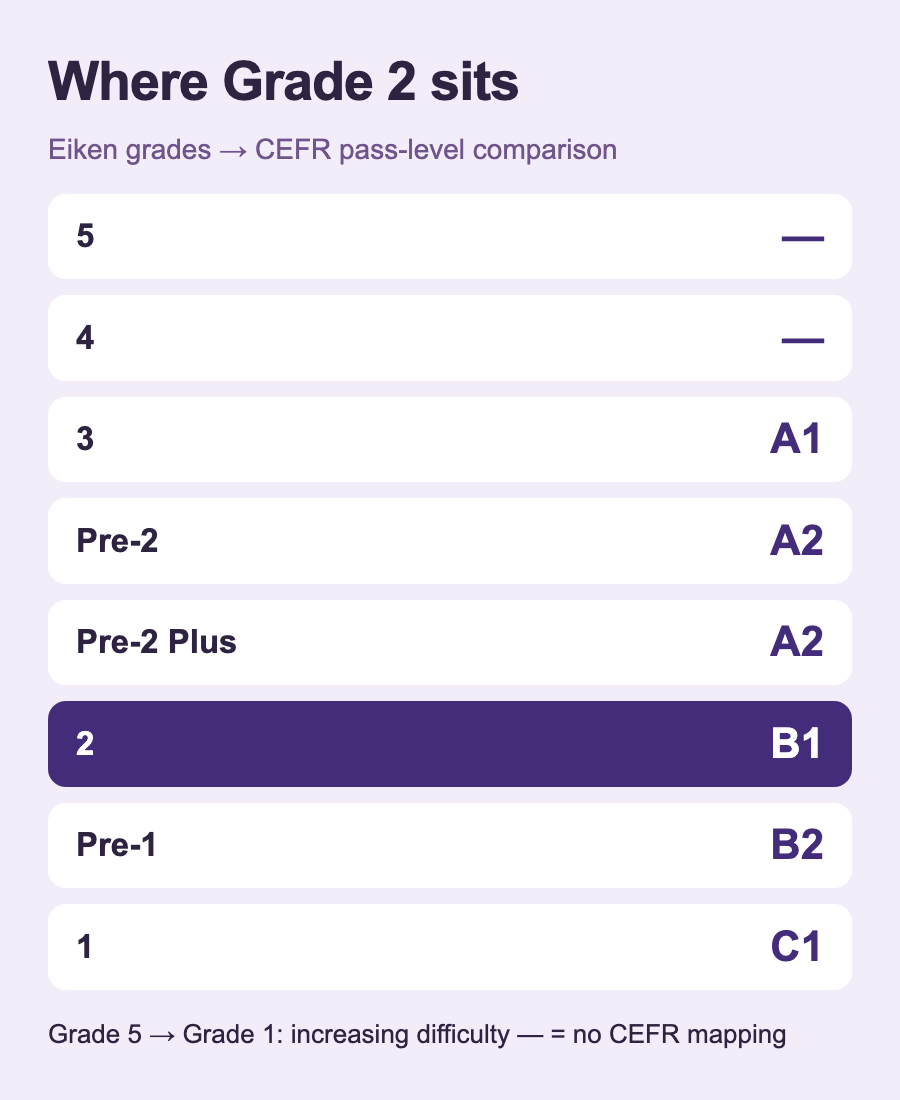
The numbering runs towards Grade 1 as difficulty increases. Grade 2 is the third-highest of eight grades, above Pre-2 Plus and below Pre-1. “Pre” means the step before the numbered grade; it is part of the qualification’s name.
| Grade, from entry to advanced | CEFR pass-level comparison |
|---|---|
| 5 | No CEFR mapping |
| 4 | No CEFR mapping |
| 3 | A1 |
| Pre-2 | A2 |
| Pre-2 Plus | A2 |
| 2 | B1 |
| Pre-1 | B2 |
| 1 | C1 |
The Foundation’s English grade comparison gives these CEFR levels; its CSE guidance explains that Grades 4 and 5 are outside the CEFR reporting range.
For a parent or teacher, “high-school graduation level” describes the target difficulty. Candidates can choose their grade regardless of age or education and do not have to pass the lower grades first (eligibility rules, in Japanese).
Official information you can read in English
The Foundation’s About Grade 2 page explains its purpose and skill targets in English. The speaking-test guide explains the face-to-face interview and lists Grade 2 as about seven minutes with one examiner. The English overview’s sample-materials section links to recent test downloads; the download pages and some booklet instructions are Japanese, while the practice passages and questions provide the English tasks. For current question counts, use the Japanese Grade 2 format page, summarized below.
CEFR B1 compared with IELTS, Cambridge and TOEIC
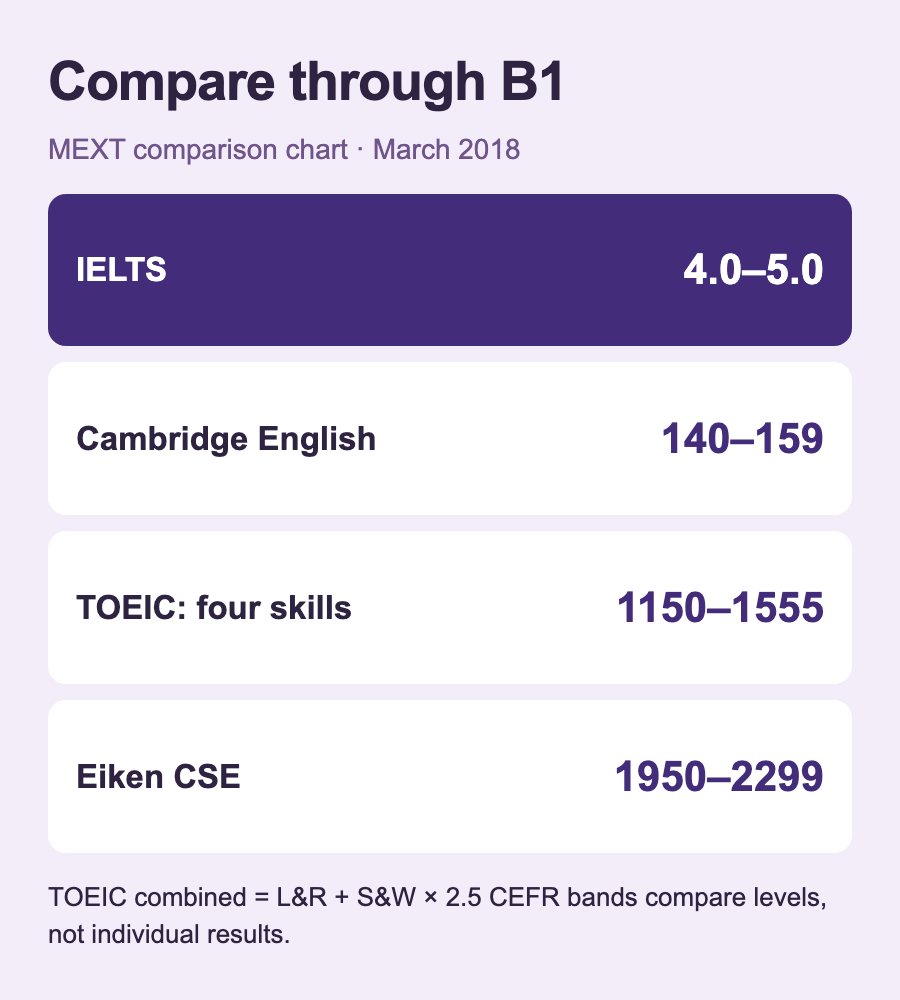
B1 describes an independent user who can follow the main points of familiar subjects and produce connected language about them. For an international reference, Japan’s education ministry, MEXT, places these scores in the B1 band:
| Assessment | B1 band in the March 2018 MEXT chart |
|---|---|
| IELTS | 4.0–5.0 |
| Cambridge English | 140–159 |
| TOEIC L&R plus S&W | 1150–1555 combined |
| Eiken CSE | 1950–2299 |
This is a comparison through CEFR, rather than a Foundation conversion guaranteeing a score on another test; the MEXT chart, reproduced on PDF page 14, specifies TOEIC L&R + 2.5 × S&W for its combined column.
Use the chart to understand the broad level, then use the receiving institution’s requirements to choose a test. A Japanese school’s deviation score, or hensachi, has no public conversion from this qualification.
Why can a Grade 2 result show A2 instead of B1?
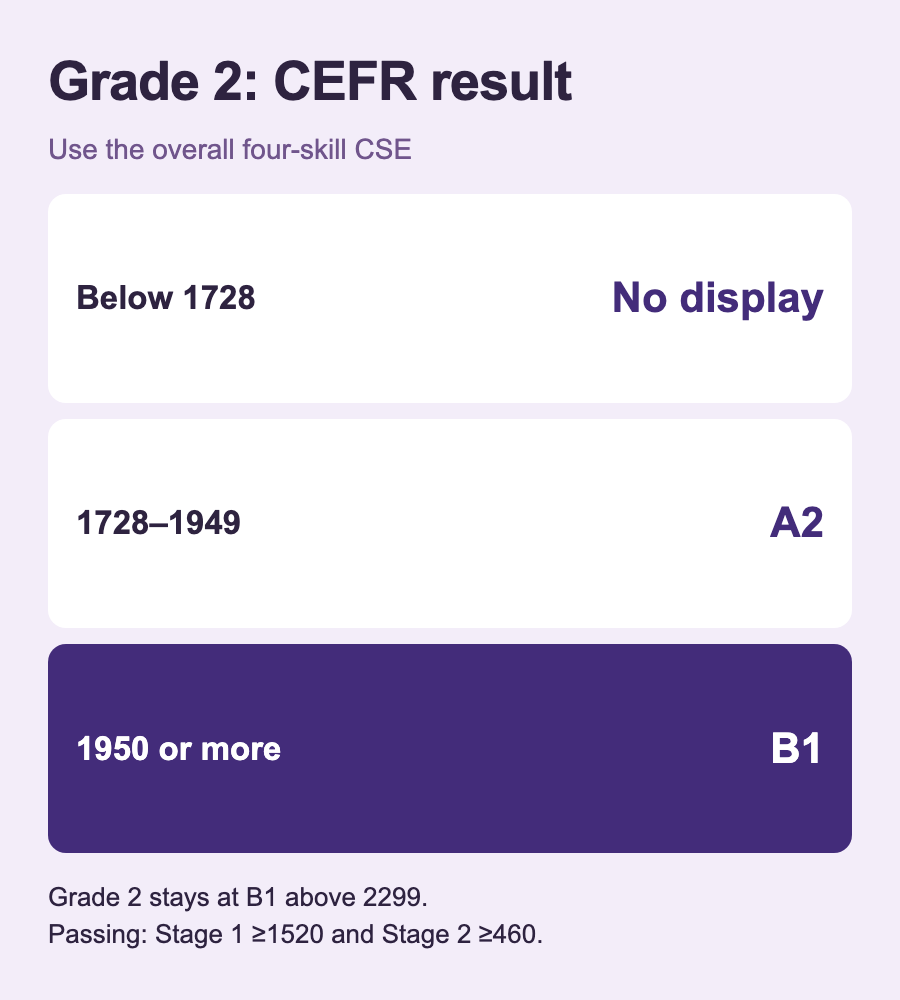
The grade describes the test you entered; the result reflects how you performed. Under the Foundation’s current CEFR reporting rules, Grade 2 overall scores are displayed as follows:
- Below CSE1728: no overall CEFR level.
- CSE1728–1949: A2.
- CSE1950–2299: B1; scores of 2300 or more remain capped at B1 for this grade.
An overall CEFR result requires all four skills. Passing is decided separately for each stage, so check both stage results even when the report shows B1.
What score or percentage passes Grade 2?
Stage 1 needs CSE1520/1950; Stage 2 needs 460/650. Reading, listening and writing each contribute up to 650 points to Stage 1. Speaking is assessed separately in Stage 2 (official scoring criteria).
The Foundation reports that, in the first session of 2016, many candidates at Grade 2 and below passed with roughly 60% in each skill. That is an observed historical pattern, not a fixed pass guarantee for a future sitting.
| Skill | Task count and 60% guideline |
|---|---|
| Reading | 31 questions 31 × 0.6 = 18.6, about 19 correct |
| Listening | 30 questions 30 × 0.6 = 18 correct |
| Writing | Summary and opinion Assess the written responses |
The question counts come from the current Grade 2 specification. Writing needs evaluation of the language and content, rather than counting one of the two tasks as “correct.”
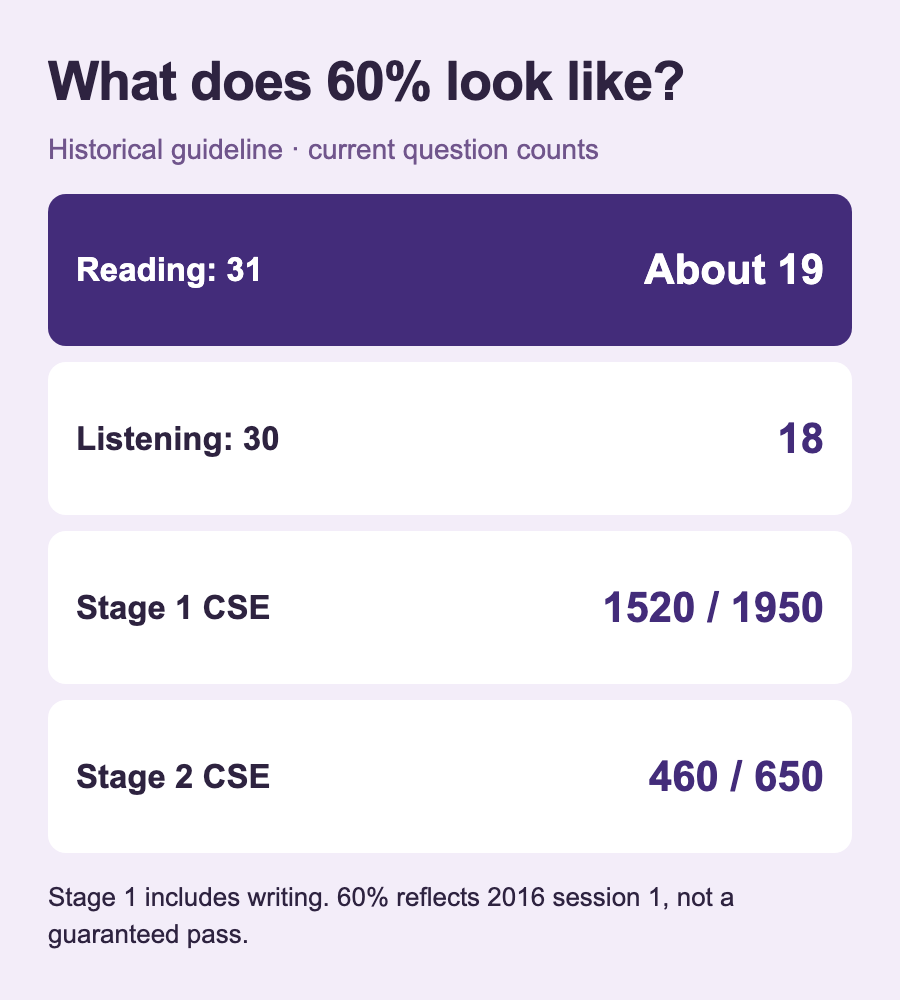
Nineteen out of 31 is about 61.3%; 18 out of 30 is 60%. Dividing 1520 by 1950 does not give the required percentage of questions correct. CSE is calculated statistically after marking the examination, and candidates cannot derive it from their raw totals. Include both writing tasks when checking readiness.
How different are the neighbouring grades?
| Grade | Benchmark and writing tasks |
|---|---|
| Pre-2 | Mid high school Email reply and opinion |
| Pre-2 Plus | Upper high school Summary and opinion |
| 2 | High-school graduation Summary and opinion |
| Pre-1 | Mid university Summary and opinion |
These school benchmarks come from the official grade guide; the tasks are detailed in the Pre-2, Pre-2 Plus, Grade 2 and Pre-1 specifications.
Moving from Pre-2 to Grade 2 means selecting information for a summary as well as expressing an opinion. Pre-2 Plus already includes a summary, but focuses on familiar social topics; Grade 2 expects more detailed understanding and expression about social subjects. In speaking, Grade 2 has a three-picture narrative, whereas Pre-1 asks for a two-minute account of four pictures.
A useful comparison is whether the learner can explain why an event happened, not just identify what happened. Our Pre-2 Plus guide and grade-selection guide cover the choice of next examination.
What does the test ask you to do?
In the conventional format, Stage 1 gives 85 minutes for reading and writing, followed by about 25 minutes of listening. Reading has 17 short-text gap questions, six passage gaps and eight comprehension questions. Listening divides into 15 conversation questions and 15 passage questions, played once (current format).
The 2026 session 2 booklet requires a 45–55-word summary and gives 80–100 words as the guideline for the opinion response. These call for different decisions: selecting the source’s essential information versus explaining your own position.
The approximately seven-minute interview includes reading a passage of about 60 words aloud, a passage question, a three-picture narrative and two questions about your views. Silent reading and narrative preparation each allow 20 seconds (interview sequence).
The Foundation’s Grade 2 Can-do list describes understanding social topics and communicating ideas in detail. These short examples illustrate parts of that work:
| Skill | Action and example |
|---|---|
| Reading | Track a proposal and its purpose The council plans to lend tools so residents can repair things instead of replacing them. |
| Listening | Retain a change and its cause The outdoor workshop has moved indoors because strong winds are expected. |
| Speaking | Explain a preference with a reason I would support a later bus because evening workers need a way home. |
| Writing | Connect a solution with its effect Clearer recycling labels could help visitors choose the right bin. |
Use full official tasks after these short illustrations. Recognizing a sentence is only one part of following a long argument, writing a summary or responding to an examiner.
Is there a published pass rate?
There is no current published grade-level pass rate on the Foundation’s participation page. When a percentage appears in search results, check its year, whether it covers the first or second stage, and who was counted: the Foundation’s July 2016 release, for example, uses high-school candidates for Stage 1 and all candidates for Stage 2. A rate for that earlier group is different from the probability that a particular learner will pass now.
A six-step readiness check using official material
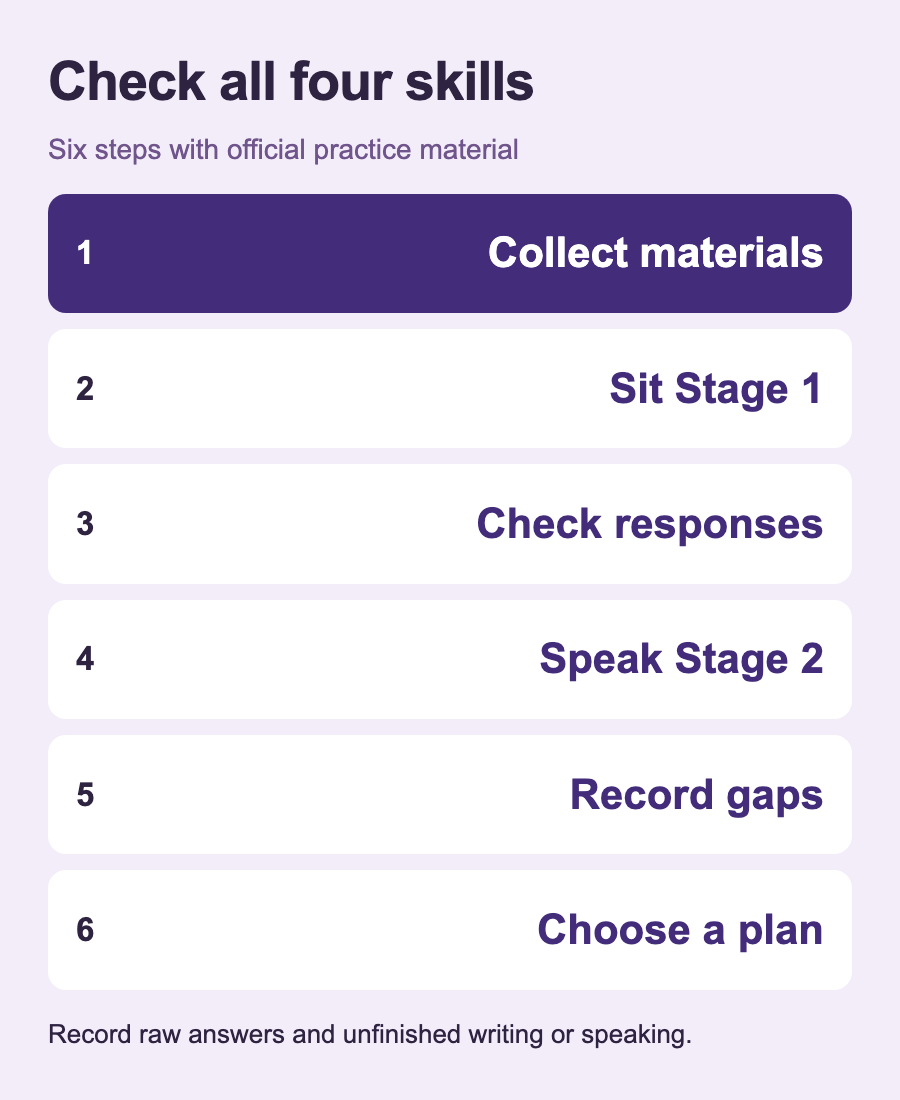
- Collect one complete sitting. Use the Foundation’s Grade 2 download page for the booklet, answers and listening audio; add its interview sample.
- Work to the published time. Write both responses inside the 85 minutes and play the listening without pauses. Mark anything left unfinished.
- Check responses by skill. Match reading and listening against the answer key. For writing, check missing information, organization and reasons; ask a teacher to evaluate responses you cannot judge confidently.
- Attempt the interview aloud. Include the picture story and opinion answers, as well as reading. You can record home practice; the actual interview rules prohibit recording and photography during the examination.
- Name one observable gap. A useful note might be “I described the pictures but missed the change between them.” That gives the next practice a specific purpose.
- Choose the next grade or preparation task. Compare Pre-2 Plus material if Grade 2 is still hard to follow. If Grade 2 fits, make room for writing and spoken answers in your plan, alongside reading and listening.
What should a school or employer check?
Start with the exact wording on the application. “Grade 2 pass,” “overall CSE” and “CEFR B1” can impose different requirements. The Foundation’s admissions checklist asks applicants to confirm accepted formats and conditions with their destination.
For a school, identify the department, entry year and admissions route. Then check the required score, permitted test dates, certificate and submission deadline. For employment, consult the specific vacancy’s criteria. The qualification’s broad level helps interpret a document; the recipient determines how it is used.
Practise an opinion without reading it
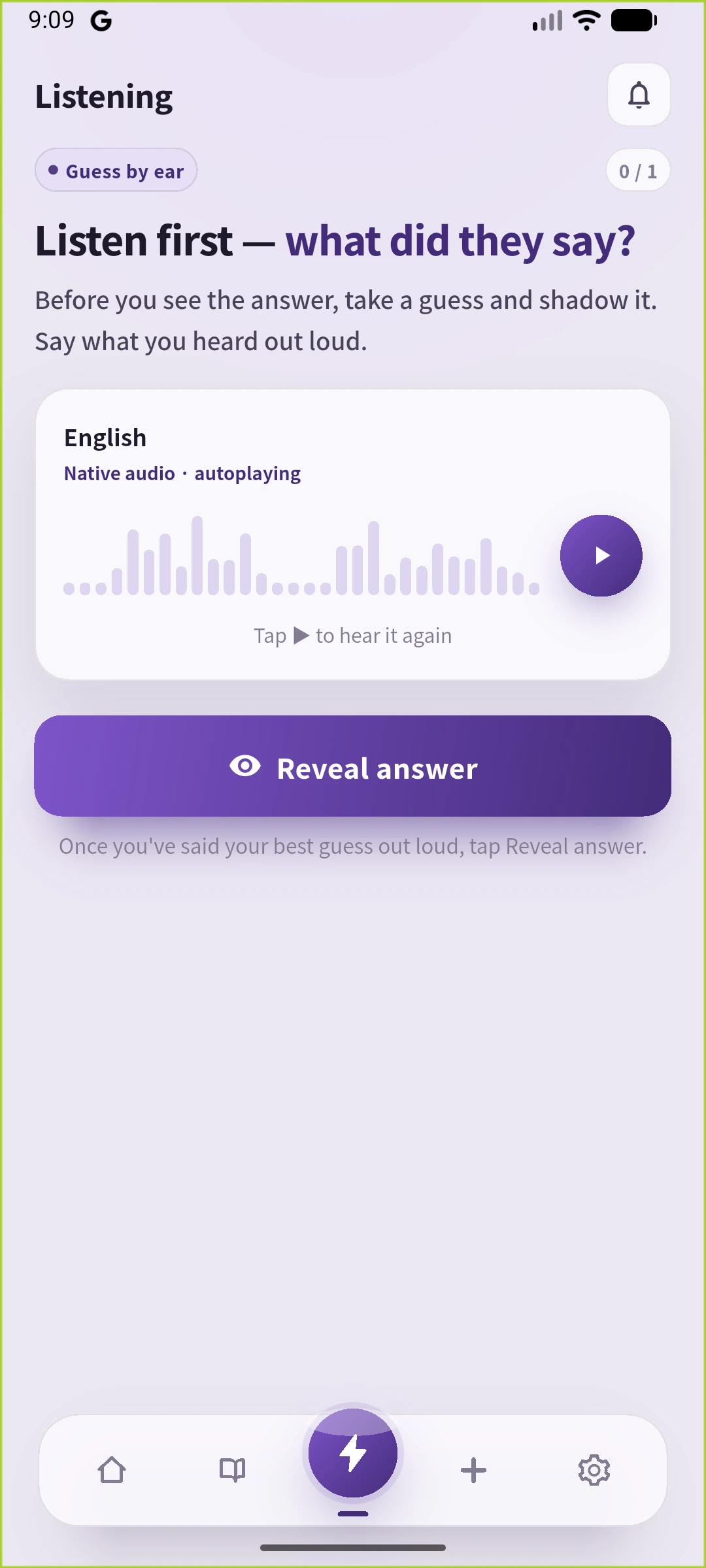
For a short opinion-and-reason exercise, our app SpeakGain lets a learner listen with the sentence hidden before revealing the answer. The sentence saved for this article is:
I think public parks are important because they give people a place to relax.
Say the sentence after listening, then reveal it and check whether both the opinion and its reason came through. Once that is comfortable, answer an interview-style opinion question using a reason of your own.
Frequently asked questions
Is Eiken Level 2 the same as Grade 2?
“Grade 2” is the Foundation’s English name for the qualification often searched as “Level 2.” It is the third-highest of the eight current grades, with B1 as its pass-level comparison.
How many correct answers are roughly 60%?
For the current test, about 19 of 31 reading answers and 18 of 30 listening answers. The historical 60% observation covered individual skills, and writing also counts towards Stage 1.
What are the passing scores?
The thresholds are CSE1520 for Stage 1 and 460 for Stage 2. The Foundation assesses each stage separately, with maximum scores of 1950 and 650 respectively.
What IELTS level is comparable?
MEXT’s March 2018 chart places IELTS4.0–5.0 in the same B1 band as the Grade 2 benchmark. Check the institution’s own IELTS requirement if you intend to submit that test instead.
Can an adult take Grade 2 without earlier Eiken certificates?
Yes. The eligibility rules allow candidates regardless of age or educational background and do not require a lower-grade pass.
Reading a Grade 2 result with confidence
Look for three things: the grade taken, the pass result for each stage, and the reported CSE or CEFR required by the destination. For a learner deciding whether to enter, a full set of official tasks gives a more useful next step than the school-stage label alone: it shows which reading, writing, listening or speaking action still needs work.
Source guide
- The English Eiken overview explains who runs the test and how its grades work.
- The CSE guide provides the score thresholds and CEFR display limits used here.
- The MEXT presentation containing the March 2018 comparison chart supplies the cross-test score bands on PDF page 14.
Eiken is a registered trademark of the Eiken Foundation of Japan.